
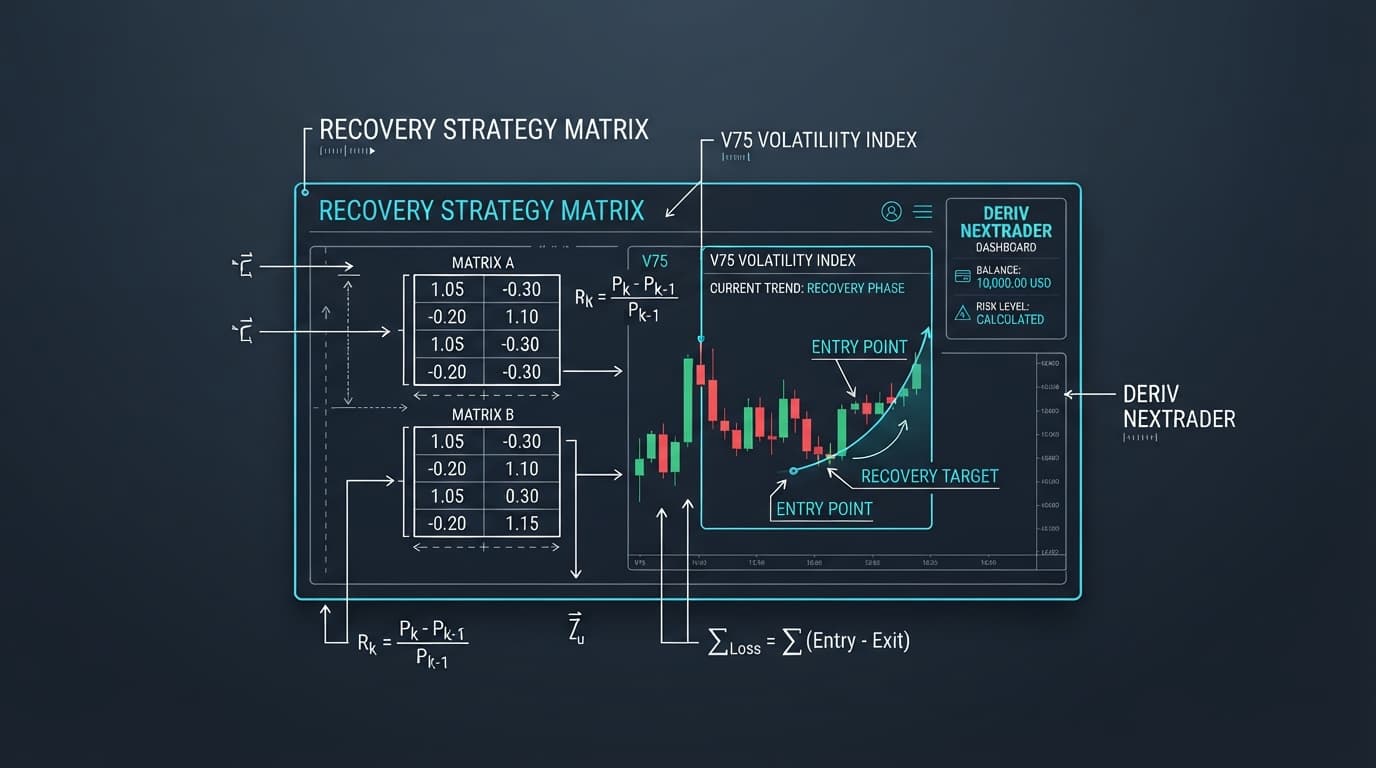
Trading synthetic indices like Volatility 75 (V75) or Volatility 100 (1Hz) with fixed doubling multipliers causes severe drawdowns during range-bound price action. When contract payouts sit below 100%, unhedged Martingale sequences generate a mathematical deficit where stake risk expands faster than potential returns. Using a structured deriv money management calculator establishes precise stake sizing tables, hard sequence caps, and payout-adjusted recovery steps before entering a trade.
Standard 2.0x compounding multipliers on Rise/Fall contracts operate on the assumption that a single win recovers all cumulative losses. When synthetic payouts drop to 85% or 90%, standard doubling math leaves structural deficits.
By calculating exact stake requirements based on account balance, target payout percentages, and sequence limits, you cap drawdown exposure while maintaining structured loss recovery across Deriv synthetic index markets.
What This Fixes
The primary operational risk when trading Deriv synthetic indices is managing consecutive loss sequences. On Volatility 75 Index, tight consolidation can produce 5 or 6 consecutive losing trades when price whipsaws across moving averages. With a standard 2.0x Martingale sequence and a $1.00 base stake, five consecutive losses require stakes of $1.00, $2.00, $4.00, $8.00, and $16.00.
Get Live AI Trading Signals
Real-time non-repaint signals from 11 AI strategies — Volatility Indices, Forex, Gold & Crypto. No subscription, no paywall.
- Auto Trader Bot
- Digit Trader Bot
- 11 AI Strategies
- Live Telegram Signals
This 5-loss sequence creates a cumulative exposure of $31.00. On a $200 account, that single sequence risks 15.5% of total balance. With a $5.00 base stake, a 5-loss sequence forces stakes of $5.00, $10.00, $20.00, $40.00, and $80.00, pushing total sequence exposure to $155.00—risking over 75% of a $200 account balance on a single streak.
Standard doubling assumes a 100% payout rate. On Rise/Fall or Higher/Lower contracts where payouts range between 80% and 95%, fixed doubling fails mathematically because winning trades do not fully recover accumulated losses. Using dedicated deriv trading tools replaces unhedged multipliers with explicit calculation matrices that adjust initial stakes and recovery sequences according to actual payout rates.
Quick Setup Check
Verify your account risk limits inside Nextrader App before executing automated strategies:
- API Connection: Connect your Deriv account inside Nextrader App using a WebSocket API token.
- Risk Parameters: Set a hard sequence risk cap (e.g., 15% maximum drawdown limit per loss sequence) inside the bot money management settings.
- Bot Engine: Select the Nextrader Auto Trader Bot configured for Rise/Fall or Higher/Lower contracts on Volatility 75 or Volatility 100 (1Hz) Index.
- Signal Condition: Select named AI strategies like Smart Fusion or Trend Hunter on 5-minute or 10-minute timeframes, requiring 3 to 4 indicators to agree before triggering entry signals.
Fix 1: Use a Deriv Money Management Calculator to Set Sequence Exposure Limits
The immediate cause of severe drawdown is failing to define a maximum sequence cap before executing trades. When automation runs without explicit exposure limits across consecutive losses, normal statistical loss clusters exhaust available equity.
To calculate maximum exposure for a standard doubling sequence on a 100% payout contract:
$$\text{Total Exposure} = \text{Base Stake} \times (2^N - 1)$$
Where $N$ represents the maximum consecutive loss steps allowed before halting the sequence. Reverse-engineer your base stake by dividing your maximum dollar risk allowance by $(2^N - 1)$:
$$\text{Base Stake} = \frac{\text{Max Exposure}}{2^N - 1}$$
Applying a standard 2.0x multiplier sequence with a $1.00 base stake across 6 steps produces the following exposure progression:
| Step ($N$) | Individual Stake | Cumulative Loss | Exposure % ($200 Account) | Return at 90% Payout | Sequence Net Profit/Deficit |
|---|---|---|---|---|---|
| 1 | $1.00 | $1.00 | 0.5% | $0.90 | +$0.90 |
| 2 | $2.00 | $3.00 | 1.5% | $1.80 | -$0.20 |
| 3 | $4.00 | $7.00 | 3.5% | $3.60 | -$0.40 |
| 4 | $8.00 | $15.00 | 7.5% | $7.20 | -$0.80 |
| 5 | $16.00 | $31.00 | 15.5% | $14.40 | -$1.60 |
| 6 | $32.00 | $63.00 | 31.5% | $28.80 | -$3.20 |
To structure risk accurately across various account sizes using a 5-step sequence cap ($N = 5$), use this stake sizing matrix:
| Account Balance | Max Sequence Risk (10% Cap) | Max Sequence Risk (15% Cap) | Calculated Base Stake (100% Payout) | Calculated Base Stake (85% Payout) |
|---|---|---|---|---|
| $100 | $10.00 | $15.00 | $0.48 | $0.35 |
| $200 | $20.00 | $30.00 | $0.96 | $0.70 |
| $500 | $50.00 | $75.00 | $2.41 | $1.76 |
| $1,000 | $100.00 | $150.00 | $4.83 | $3.52 |
Inside Nextrader App, you input these exact calculated caps into the Auto Trader Bot settings panel. Defining hard sequence limits stops the bot engine from escalating into 6th or 7th trades ($32.00 and $64.00 stakes), preserving account equity during extended consolidation.
Fix 2: Replace Martingale Multipliers in Deriv Bots with Mesa Milano Recovery
Traders searching for deriv bots or DBot often import XML files or build block-based scripts on demo accounts to execute automated strategies. However, standard block configurations on DBot typically rely on rigid multipliers (like 2.0x or 2.1x) that double stakes after every loss. When Volatility 75 Index enters tight consolidation, fixed multiplier scripts continuously double position sizes into range chop.
Nextrader App replaces rigid stake doubling with the Mesa Milano smart loss recovery engine inside its Auto Trader Bot. Instead of requiring a single high-stake trade to recover 100% of accumulated sequence losses, Mesa Milano distributes recovery across multiple subsequent trades.
| Sequence Step | Outcome | Fixed Martingale (2.18x) Stake | Mesa Milano Recovery Stake | Sequence Net Loss Exposure |
|---|---|---|---|---|
| Trade 1 | Loss | $1.00 | $1.00 | -$1.00 |
| Trade 2 | Loss | $2.18 | $1.50 | -$2.50 (vs -$3.18) |
| Trade 3 | Win | $4.75 | $2.20 | Recovers $1.87 of loss |
| Trade 4 | Win | — | $2.20 | Completes sequence recovery |
When trade 1 ($1.00) and trade 2 ($1.50) lose on a Rise/Fall contract paying 85%, standard doubling forces a $4.75 stake on trade 3. Mesa Milano calculates a controlled stake ($2.20) that recovers the $2.50 loss over two consecutive winning entries, keeping peak trade exposure significantly lower.
This multi-tiered approach prevents exponential stake growth during range-bound market phases while maintaining a systematic path back to account profitability.
Fix 3: Sync Stake Multipliers to Deriv Synthetic Contract Payout Math
A common oversight when setting up automated risk rules is ignoring contract payout variations. Higher/Lower and Rise/Fall contracts on synthetic indices do not pay a fixed 100% return; payouts adjust based on barrier offset and index selection.
If you trade a Higher/Lower contract on Volatility 100 (1Hz) Index with an 85% payout return using a standard 2.0x multiplier, winning trade 3 creates an exposure deficit:
- Trade 1: Stake $1.00 $\rightarrow$ Loss (Net: -$1.00)
- Trade 2: Stake $2.00 $\rightarrow$ Loss (Net: -$3.00)
- Trade 3: Stake $4.00 $\rightarrow$ Win (Payout 85% = +$3.40 return)
- Sequence Result: -$3.00 + $3.40 = +$0.40 net gain.
If payouts drop to 70% due to barrier shifts:
- Trade 3: Stake $4.00 $\rightarrow$ Win (Payout 70% = +$2.80 return)
- Sequence Result: -$3.00 + $2.80 = -$0.20 net loss despite winning the recovery trade.
| Contract Payout Yield | Required Recovery Multiplier (1-Step Recovery) | Multiplier Calculation Formula | Net Result on Step 3 Win (Standard 2.0x) |
|---|---|---|---|
| 100% | 2.00x | $1 + (1 / 1.00) = 2.00$ | +$1.00 (Full Profit) |
| 90% | 2.11x | $1 + (1 / 0.90) = 2.11$ | -$0.20 (Deficit) |
| 85% | 2.18x | $1 + (1 / 0.85) = 2.18$ | -$0.40 (Deficit) |
| 75% | 2.33x | $1 + (1 / 0.75) = 2.33$ | -$1.00 (Deficit) |
| 70% | 2.43x | $1 + (1 / 0.70) = 2.43$ | -$1.40 (Deficit) |
Nextrader App resolves this payout gap. The Auto Trader Bot engine reads live contract payout percentages directly from the Deriv WebSocket API. When running Mesa Milano smart loss recovery or custom fixed multipliers, Nextrader App automatically recalculates required stake sizes based on real-time payout yields, ensuring every successful recovery step achieves positive net profitability.
Fix 4: Filter Execution with High-Confidence AI Trading Signals
Executing automated trades on raw tick fluctuations or unverified crossovers increases consecutive loss streaks, testing the boundary of any money management model. To reduce trade frequency during choppy market conditions, connect execution rules to real-time ai trading signals generated inside Nextrader App.
Nextrader App provides non-repaint signals that fire strictly on closed candles when 3 to 4 technical indicators align. Signal confidence ratings range between 30% and 85% based on indicator agreement across 4 timeframes (5min, 10min, 30min, and 1 hour).
Configure execution rules in Nextrader App using these steps:
- Select Named AI Strategies: Choose multi-indicator strategies such as Smart Fusion (combines multiple indicators) or Trend Hunter (EMA trend alignment) inside the app.
- Timeframe Selection: Set trade analysis to 5-minute or 10-minute closed candles. Closed candles prevent repainting and reduce false breakouts associated with tick-level volatility.
- Indicator Confluence: Require a minimum of 3 to 4 independent indicators (such as RSI, MACD, SuperTrend, or Ichimoku) to agree before the system issues an entry signal with Entry, Stop Loss, TP1, and TP2 targets.
- Confidence Filter: Filter execution by signal confidence (30% to 85%), executing trades only when indicator alignment meets your defined criteria.
Keeping It Stable
- Monitor Live P&L and Sequence Logs: Track active sequence steps, open contract trades, and real-time balance metrics using the color-coded console on Nextrader App or the Nextrader Android App (
com.vm.nextrader). - Enforce Daily Loss Stop-Out Limits: Set a global account stop-loss limit inside the Auto Trader Bot parameters. For example, configure a 10% maximum daily account balance draw limit ($20 on a $200 account) to halt bot trading automatically if a session limit is reached.
- Diversify with Digit Trader Bot Features: Allocate a portion of trading balance to Digit Trader Bot setups (using AI last-digit predictions for DIGITEVEN/ODD, OVER/UNDER, or MATCH/DIFF) analyzing 50 to 500 digit histories and streak frequency data.
- Multi-Account Risk Isolation: Use multi-account management inside Nextrader App to run distinct risk profiles (e.g., Fixed Stake money management on 5m Swift Scalper signals on account A, and Mesa Milano recovery on 10m Trend Hunter signals on account B).
- Share Presets in the Telegram Community: Cross-reference strategy presets and timeframe settings with other traders in the official Telegram group (
Telegram).
Start Now
Stop letting unhedged 2.0x Martingale multipliers destroy your trading capital. Transition your automated execution to precise, dynamic risk models today:
- Launch the free Nextrader App directly in your browser at Nextrader App.
- Create your free account or log in at Sign Up Free — Nextrader.
- Connect your Deriv account using a secure WebSocket API token and open the Auto Trader Bot setup panel.
- Select Volatility 75 or Volatility 100 (1Hz) Index and switch your money management engine from standard Martingale to Mesa Milano.
- Pair execution with 5-minute closed-candle Smart Fusion signals filtering for indicator confluence.
- Join our community on Telegram at Telegram to access real-time strategy updates and share configuration presets with traders worldwide.
Trading involves risk. Past performance does not guarantee future results.