
Introduction
Welcome to this comprehensive tutorial designed for traders eager to leverage cutting-edge deriv trading tools to automate their strategies. In this guide, we'll walk you through the process of setting up Nextrader's powerful Auto Trader Bot to automatically execute Rise/Fall contracts on the Deriv Volatility 75 Index. Specifically, we'll focus on utilizing the intelligent Volatility Pulse strategy for signal generation and the robust Mesa Milano money management system for smart capital protection and recovery.
By the end of this tutorial, you will have a fully configured automated trading system on Nextrader, ready to trade the V75 Index on your Deriv account. This setup empowers you to capitalize on market opportunities around the clock, free from manual intervention, making it an essential skill for anyone looking to optimize their trading efficiency with advanced binary bots.
What You Need Before Starting
- Deriv Account: A live or demo trading account with Deriv.com.
- Nextrader Account: A free Nextrader account (signup at Sign Up Free — Nextrader).
- Basic Understanding: Familiarity with the Volatility 75 Index and Rise/Fall contract types on Deriv.
- Stable Internet Connection: Essential for uninterrupted bot operation.
Step 1: Accessing the Auto Trader Bot and Connecting Your Deriv Account
Your first step is to navigate to the heart of Nextrader's automation capabilities: the Auto Trader Bot. This is where your journey into automated deriv bots begins.
- Log In to Nextrader: Open your web browser and go to Nextrader App. Log in with your credentials. If you don't have an account, signing up is quick, easy, and 100% free – no subscriptions or paywalls.
- Navigate to Auto Trader Bot: Once logged in, look for the "Auto Trader Bot" option in the main navigation menu or dashboard. Click on it to access the bot's interface.
- Connect Your Deriv Account: Within the Auto Trader Bot section, you'll find an area to connect your Deriv account. Nextrader integrates seamlessly with Deriv via their WebSocket API (using App ID 67545). You'll need to generate an API token from your Deriv account and paste it into the designated field on Nextrader. This secure connection allows Nextrader to execute trades on your behalf.
- Select Market and Contract Type:
* From the "Market" dropdown, select "Volatility 75 Index" (V75).
Get Live AI Trading Signals
Real-time non-repaint signals from 11 AI strategies — Volatility Indices, Forex, Gold & Crypto. No subscription, no paywall.
- Auto Trader Bot
- Digit Trader Bot
- 11 AI Strategies
- Live Telegram Signals
* From the "Contract Type" dropdown, choose "Rise/Fall." This tells the bot to exclusively trade these specific contract types on the V75 market.
Step 2: Configuring the Volatility Pulse Strategy and Timeframe
With your Deriv account connected and the market/contract type selected, it’s time to choose the intelligence that will drive your trades: the Volatility Pulse strategy. Nextrader offers 11 named AI strategies, each designed for different market conditions.
- Choose Volatility Pulse: Locate the "AI Strategies" dropdown menu within the Auto Trader Bot settings. From the list of powerful options like Trend Hunter, Reversal Radar, and Momentum Wave, select "Volatility Pulse."
- Understand Volatility Pulse: The Volatility Pulse strategy is primarily based on Bollinger Bands, a classic indicator for measuring market volatility and identifying potential overbought or oversold conditions. It excels at spotting potential reversals when prices move too far from their average, signaling opportunities for Rise or Fall contracts. Nextrader's signals are non-repaint and only fire on CLOSED candles, ensuring reliability, and require a minimum of 3-4 indicators to agree before a signal is generated, boosting confidence.
- Select a Timeframe: Next, choose your preferred timeframe for signal generation. Nextrader provides signals across 5min, 10min, 30min, and 1-hour intervals. For Volatility 75 Index, which can be quite dynamic, a faster timeframe like "5min" or "10min" is often suitable for Rise/Fall contracts, allowing the bot to react quickly to volatility shifts. Experimentation is key to finding your optimal timeframe.
- Observe Confidence Levels: As you select the strategy and timeframe, notice that Nextrader signals come with varying confidence levels (typically 30–85%). While the bot will execute based on the strategy, these levels provide insight into the strength of each potential trade.
Step 3: Setting Up Mesa Milano Money Management
Money management is paramount for sustainable trading. Nextrader's Auto Trader Bot offers sophisticated options, and for this tutorial, we'll implement the intelligent Mesa Milano system.
- Navigate to Money Management: In the Auto Trader Bot interface, find the "Money Management" section.
- Select Mesa Milano: You'll see options like Fixed Stake and Martingale. Choose "Mesa Milano."
- Configure Mesa Milano:
* Initial Stake: Set your starting stake per trade (e.g., $1, $5, $10). This is the amount the bot will risk on the first trade after a winning streak or at the start.
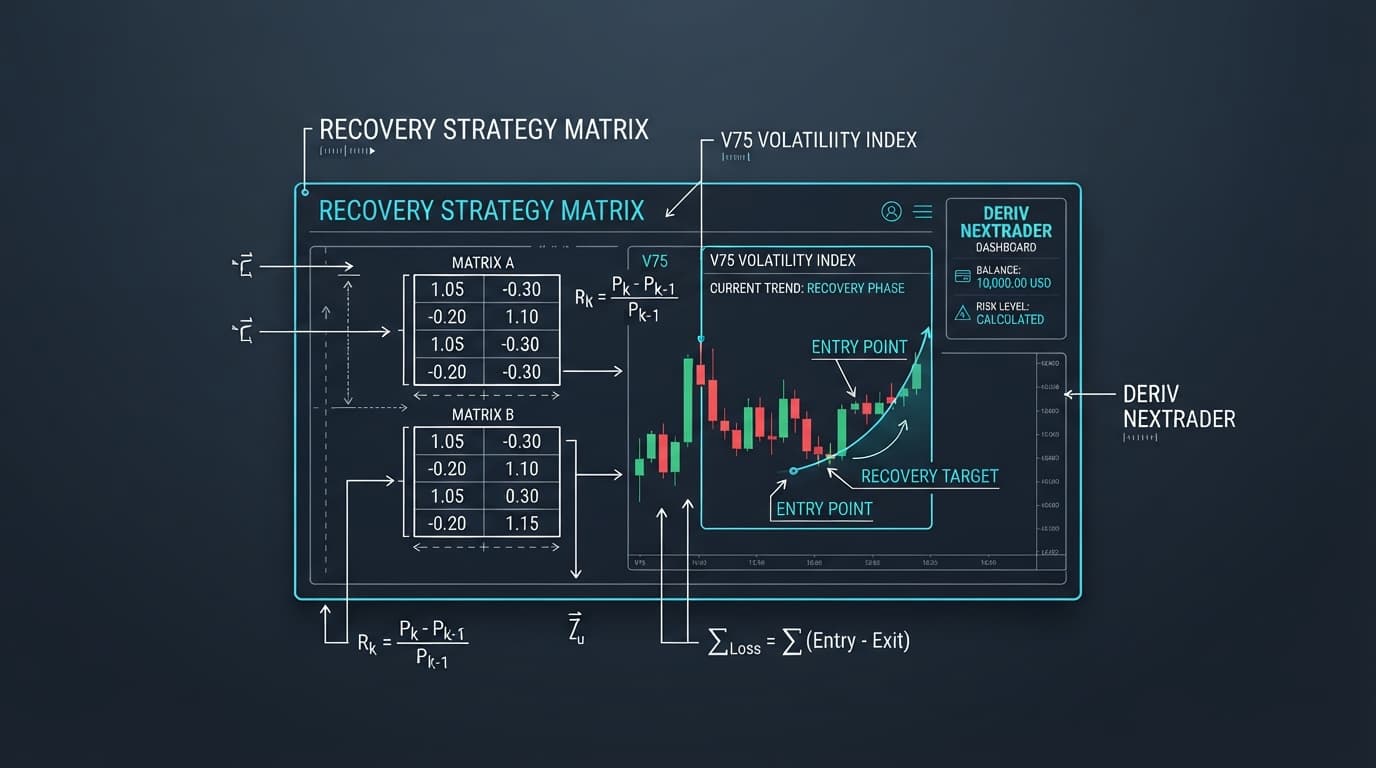
* Target Profit: Define a small target profit percentage you aim to recover on top of losses (e.g., 1-2% of your initial stake). Mesa Milano is a smart loss recovery strategy designed to recoup previous losses plus a small profit, without the aggressive compounding of Martingale. It intelligently adjusts the stake after a loss to recover the deficit from the previous trade(s) while aiming for a modest profit.
* Max Loss Limit: This is a critical safety feature. Set a clear "Max Loss Limit" (e.g., $50, $100). If the accumulated losses during a Mesa Milano sequence reach this limit, the bot will pause or revert to the initial stake, protecting your capital from extended drawdowns.
- Understand Mesa Milano's Function: Unlike a simple fixed stake, Mesa Milano dynamically calculates the next stake amount after a loss. It aims to recover the lost amount from the previous trade(s) plus your specified target profit, resetting to the initial stake upon a win. This makes it a powerful tool for managing drawdowns while maintaining growth potential, a key feature among advanced deriv trading tools.
Step 4: Defining Overall Risk Limits and Trade Duration
While Nextrader's signals provide Entry Price, Stop Loss, and Take Profit 1 & 2 as guidance for each potential trade, when automating Rise/Fall contracts, your bot's operational limits are crucial for overall risk management.
- Set Max Trades per Day: Locate the "Max Trades per Day" setting. This limits the total number of trades your bot will execute within a 24-hour period. Setting a reasonable number (e.g., 20-50) prevents overtrading, especially during volatile periods.
- Define Max Loss per Day: This is another vital safeguard. Set a "Max Loss per Day" (e.g., $200). If your cumulative losses from all trades within a day reach this threshold, the bot will automatically stop trading for the remainder of the day, helping to preserve your capital. This is a fundamental aspect of responsible trading with deriv bots.
- Specify Trade Duration: For Rise/Fall contracts, you need to tell the bot how long each contract should last. In the "Trade Duration" setting, you can typically choose between "Ticks" or "Minutes." For V75 Rise/Fall, a duration of "5 Ticks" or "1 Minute" is common, but this can be adjusted based on your analysis and the chosen timeframe for signals.
- Review Signal Information: Although the bot's primary action for Rise/Fall is to execute the contract based on the signal, Nextrader's real-time signals provide valuable data like "Entry Price," "Stop Loss," and "Take Profit 1 & 2." These levels offer insight into the signal's conviction and potential movement, which can be useful for manual traders or for understanding the bot's decisions. The bot will execute the Rise/Fall based on the signal's direction.
Step 5: Activating the Bot and Monitoring Performance
With all your settings configured, you're ready to unleash your automated trading system.
- Review All Settings: Before proceeding, meticulously review every setting you've configured: market, contract type, Volatility Pulse strategy, timeframe, Mesa Milano parameters (initial stake, target profit, max loss limit), Max Trades per Day, Max Loss per Day, and Trade Duration. Ensure everything aligns with your risk tolerance and trading plan.
- Start the Bot: Once confident, click the prominent "Start Bot" button. The Nextrader Auto Trader Bot will now begin listening for Volatility Pulse signals on the Volatility 75 Index within your chosen timeframe. When a signal (meeting the 3-4 indicator agreement) is generated, the bot will automatically place a Rise or Fall contract on your connected Deriv account, managing stakes according to Mesa Milano.
- Monitor Performance: Keep an eye on the "Real-time Trading Console" within Nextrader. This console provides live updates on executed trades, P&L tracking (profit and loss), and signal details, all color-coded for easy interpretation. You can also monitor your Deriv account directly. Nextrader's multi-account support allows you to manage several Deriv accounts from one interface, and the Android app (com.vm.nextrader) enables on-the-go monitoring.
- Pause/Stop the Bot: At any time, you can pause or stop the bot using the corresponding buttons. It's advisable to start with a Deriv demo account to thoroughly test your setup before moving to a real money account.
Pro Tips
- Start with Demo First: Always initiate your automated trading on a Deriv demo account. This allows you to fine-tune your Volatility Pulse settings, Mesa Milano parameters, and overall risk limits without financial risk. Only transition to a live account once you've proven the strategy's efficacy in simulated conditions.
- Optimize Timeframes and Confidence: Experiment with different timeframes (5min, 10min, 30min, 1 hour) for the Volatility Pulse strategy on V75. Observe how signal confidence levels correlate with trade outcomes. Sometimes, higher confidence signals, even if less frequent, yield better results.
- Explore Other AI Strategies: While Volatility Pulse is excellent for identifying reversals, Nextrader offers other powerful AI strategies like Trend Hunter (EMA crossover), Momentum Wave (MACD), and the advanced Smart Fusion (multi-indicator) or Smart Signals (4+ indicators). Don't hesitate to explore these to diversify your deriv trading tools.
- Strict Risk Management: Even with Mesa Milano's smart recovery, never overlook setting a strict "Max Loss per Day" and "Max Trades per Day." These are your ultimate safeguards. Regularly review your bot's performance and adjust your stake and loss limits as market conditions change.
- Leverage Telegram Signals: Supplement your bot's activity by checking the Nextrader Telegram channel (Telegram). You'll receive free real-time signals for 30 markets, including Volatility Indices, every 5 minutes (max 30 signals/day). This can offer additional insights or even opportunities for manual trades.
Start Trading Now
Ready to automate your trading? Head over to Nextrader App to get started. If you're new, sign up for your free account at Sign Up Free — Nextrader. For real-time signals and community interaction, join our Telegram channel at Telegram.
Trading involves risk. Past performance does not guarantee future results.