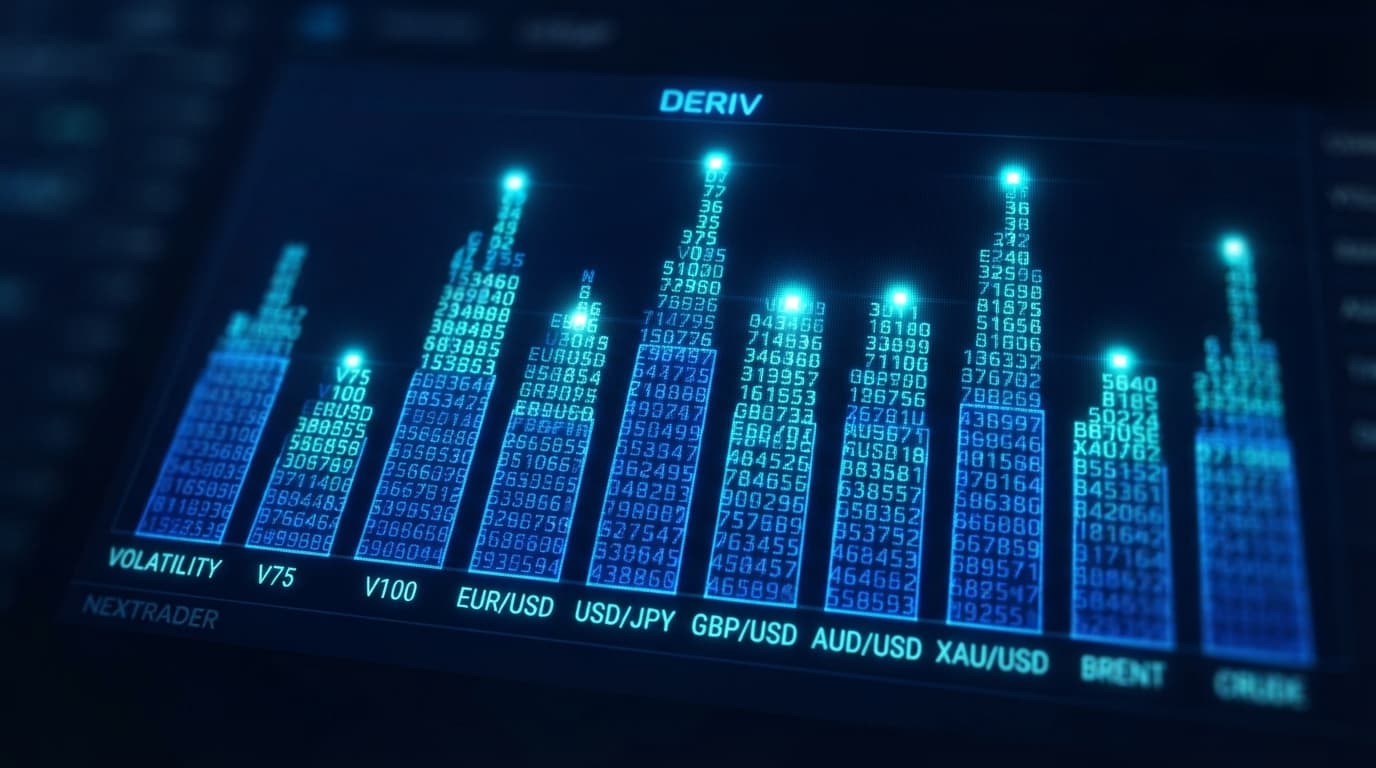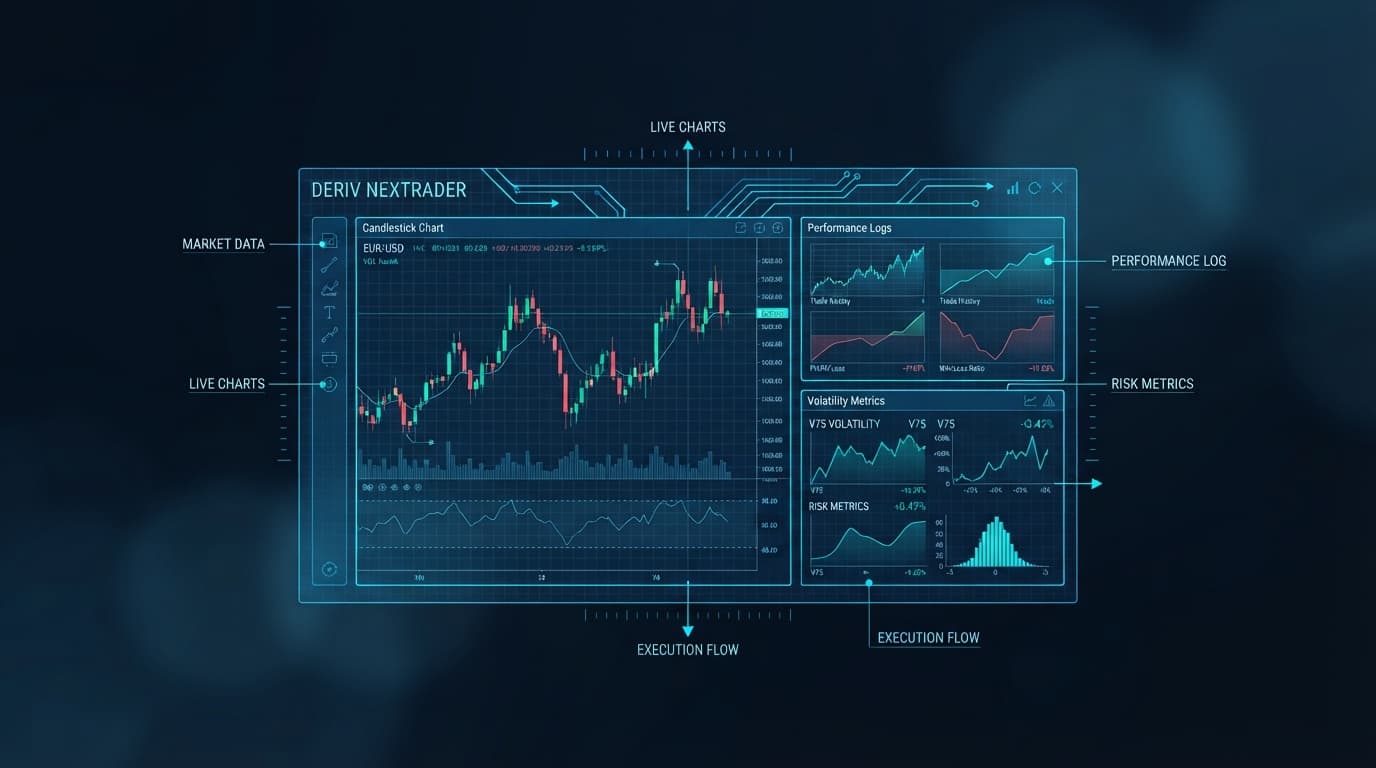
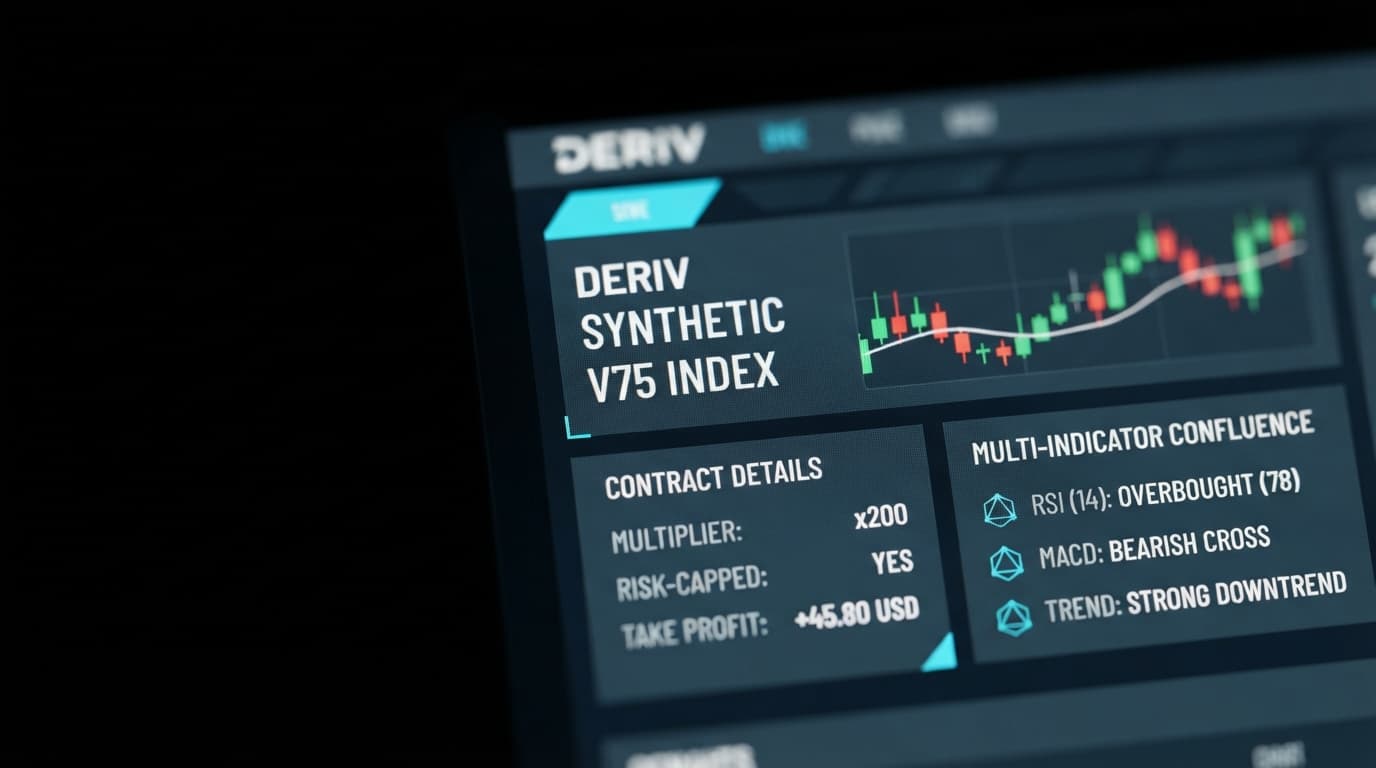
Executing a high-probability deriv multiplier strategy requires pairing non-repainting technical confluences with automated risk parameters to eliminate execution delay and emotional bias. By utilizing closed-candle signals from the Nextrader App, traders can scan live market structures across Deriv synthetic indices and forex pairs, generating clear directional biases backed by statistical indicator alignment. When a signal fires, the setup routes directly into an execution panel where Stop Loss and Take Profit levels pre-fill based on calculated risk-reward ratios, establishing systematic entry and exit rules.
Deriv Multipliers combine the upside leverage of margin trading with the limited downside risk of options contracts. When opening a position, you select a base stake and a multiplier factor—such as x100—amplifying potential gains while strictly capping your max potential loss to the initial stake amount. However, trading high-volatility assets like the Volatility 75 (V75) Index or Volatility 100 (1Hz) Index with high multipliers creates significant drawdown risk if entries rely on lagging indicators or unconfirmed candle prints.
- 1 Scan live markets on closed 1m to 1h candles
- 2 Filter setups using multi-indicator Smart Signals
- 3 Launch Quick Trade panel with pre-filled SL and TP
- 4 Monitor live P/L inside the Active Trades table
Section 1: Filtering Non-Repaint Confluences with AI Trading Signals
Generating consistent setups requires evaluating multi-indicator agreement before committing capital. The Signals page inside the Nextrader App continuously monitors real-time market data across synthetic indices (V10, V25, V50, V75, V100, and their 1Hz variants), forex pairs, commodities like gold and silver, and major cryptocurrencies. Every signal card generated by the engine evaluates technical parameters across 1-minute, 5-minute, 15-minute, and 1-hour candle timeframes, firing alerts strictly after a candle closes to eliminate indicator repainting.
Each signal card displays key decision metrics: trade direction (UP/DOWN), signal strength rating (where STRONG indicates multi-indicator alignment), timeframe, and the exact technical triggers that generated the alert. The engine deploys named strategy algorithms to isolate trade setups:
Get Live AI Trading Signals
Real-time non-repaint signals from 11 AI strategies — Volatility Indices, Forex, Gold & Crypto. No subscription, no paywall.
- Auto Trader Bot
- Digit Trader Bot
- 11 AI Strategies
- Live Telegram Signals
- Trend Hunter & Trend Rider: Use exponential moving average (EMA) crosses and SuperTrend logic to confirm directional trend continuation before opening a Multiplier position.
- Reversal Radar & Momentum Wave: Identify exhaustion points and MACD histogram shifts to spot turning points on 5m and 15m candles.
- Volatility Pulse & Breakout Beast: Apply Bollinger Band expansions and ATR dynamic volatility boundaries to capture momentum breakouts on synthetics like V75.
- Smart Signals & Smart Fusion: Require simultaneous agreement across four or more indicators (EMA, RSI, MACD, Bollinger Bands, candlestick patterns) before firing a signal card.
By relying on ai trading signals built on non-repainting closed candles, traders avoid taking trade setups during fakeouts. Filtering for cards marked STRONG ensures you only deploy capital when momentum, trend direction, and dynamic support or resistance align across multiple calculations.
Section 2: Executing a Deriv Multiplier Strategy via Quick Trade
Transitioning from signal identification to order placement must happen instantly to capture price momentum before slippage occurs. When a signal card triggers on the Signals page, clicking the card opens a signal confirmation modal displaying a suggested stake and pre-calculated risk/reward ratio. Confirming the trade opens the chart with the Quick Trade panel, pre-loaded with parameters customized to the setup.
Inside the Quick Trade panel, select Multipliers as your contract type, input your base stake, and set your desired multiplier factor (e.g., x100). The Stop Loss (SL) and Take Profit (TP) fields arrive pre-filled directly from the AI signal’s risk/reward calculation. This feature removes manual arithmetic errors, ensuring your trade enters the market with a mathematically defined exit strategy already hardcoded into the contract execution.
Once your stake, multiplier value, and pre-filled risk parameters are set, pressing UP or DOWN sends the contract directly to the Deriv WebSocket API for instant execution. Because Multipliers strictly cap downside risk at your initial stake amount, your loss is bounded by contract mechanics while allowing the trade to run toward pre-calculated profit targets.
Section 3: Active Position Management with Modern Deriv Trading Tools
The Active Trades table inside the Nextrader App displays real-time profit and loss (P/L) tick-by-tick for every open contract. This provides immediate visibility into dynamic price progression and position health without calculating payout ratios manually.
While pre-filled SL and TP targets manage fully automated exits, evolving price structure sometimes demands manual trade intervention. The Active Trades table features an early close button, enabling traders to lock in accrued profits before price reaches the TP target or cut a position early if price action shifts against the trend mid-bar.
Integrating these deriv trading tools into your daily operational routine establishes a clean execution loop:
- Scan non-repainting closed-candle alerts on the Signals page.
- Confirm suggested stake and pre-filled SL/TP levels inside the signal confirmation modal.
- Open the Quick Trade execution panel and launch the Multiplier order.
- Monitor active position P/L within the Active Trades table, exercising early close controls if price momentum deteriorates.
This systematic process removes discretionary hesitation, allowing traders to execute setups with consistent discipline.
Section 4: Deriv Multiplier Strategy Rules for Synthetic Indices and Forex
Adapting a deriv multiplier strategy across synthetic indices and forex pairs requires aligning multiplier levels, timeframes, and volatility profiles. Synthetic indices operate continuously with algorithmic volatility, whereas forex markets move based on global macroeconomic schedules and liquidity sessions.
For synthetic indices like Volatility 10 (V10), Volatility 25 (V25), Volatility 50 (V50), Volatility 75 (V75), Volatility 100 (V100), and their 1Hz continuous variants, market swings occur rapidly. When trading high-volatility assets like V75 or V100 (1Hz), select lower multiplier factors (e.g., x20 to x50) on 5-minute or 15-minute timeframes to give trades room to breathe during micro-drawdowns. Lower-volatility synthetics like V10 or V25 accommodate higher multipliers (e.g., x100 to x200) on 1-minute and 5-minute timeframes for precise momentum scalping.
When executing high-probability deriv trading signals on major forex pairs (such as EUR/USD or GBP/USD), leverage can be scaled up to x100 or higher due to lower asset volatility compared to synthetic indices. Pair 15-minute and 1-hour signal cards with the Trend Hunter or Smart Signals strategies to capture macro session moves during London and New York overlaps.
Standardizing your routine across these parameters eliminates guesswork. To learn more about standardizing signal alerts and configuring execution setups, step-by-step guides are available at Nextrader App.
Standardize Your Execution Framework Today
Start executing your Deriv Multiplier strategy with non-repainting AI signals, real-time indicator alignment, and automated SL/TP pre-fills across synthetic indices and forex markets.
- Launch the web app directly at Nextrader App
- Create your free account at Sign Up Free — Nextrader
- Join our community of active traders on Telegram at Telegram
Trading involves risk. Past performance does not guarantee future results.