Step-by-Step Guide to Configuring Mesa Milano Money Management for Smart Loss Recovery in Nextrader Auto Trader
Standard Martingale double-up systems expose trading accounts to severe tail risk. When running automated binary bots on volatile instruments like Deriv synthetic indices, a short sequence of consecutive losses can rapidly multiply your stake requirements from $1 to $32, $64, or higher, risking a total balance wipeout.
Mesa Milano money management provides a structured, mathematically conservative alternative for loss recovery. Integrated natively within the Nextrader Auto Trader system, Mesa Milano scales recovery stakes using controlled linear and fractional multiplier steps rather than aggressive 2x exponential jumps.
By spreading recovery over multiple winning trades instead of demanding an immediate single-trade turnaround, this algorithm helps stabilize your P&L curve during unexpected market whipsaws. This tutorial breaks down an actual trading session on the Volatility 100 (1s) Index using Nextrader to show you exactly how to configure and execute Mesa Milano for smart loss recovery.
The Setup
To demonstrate Mesa Milano in action, we configured a live session targeting small, consistent compounding gains while limiting maximum portfolio drawdown.
Get Live AI Trading Signals
Real-time non-repaint signals from 11 AI strategies — Volatility Indices, Forex, Gold & Crypto. No subscription, no paywall.
- Auto Trader Bot
- Digit Trader Bot
- 11 AI Strategies
- Live Telegram Signals
- Platform: Nextrader Auto Trader (Nextrader App)
- Asset: Volatility 100 (1s) Index (V100 1s)
- Contract Type: Rise / Fall (5-tick duration)
- Signal Strategy: Trend Hunter (EMA direction with a 4-indicator confirmation threshold)
- Starting Account Balance: $200.00 USD
- Base Stake: $2.00 USD
- Session Target Profit: $15.00 USD
- Session Stop Loss: $30.00 USD
- Money Management Algorithm: Mesa Milano (Initial Factor: 1.4x, Max Steps: 4)
Our goal is simple: test how Mesa Milano manages a three-trade losing streak compared to standard deriv bots, then observe how it safely Recovers lost capital when high-probability setup signals re-align.
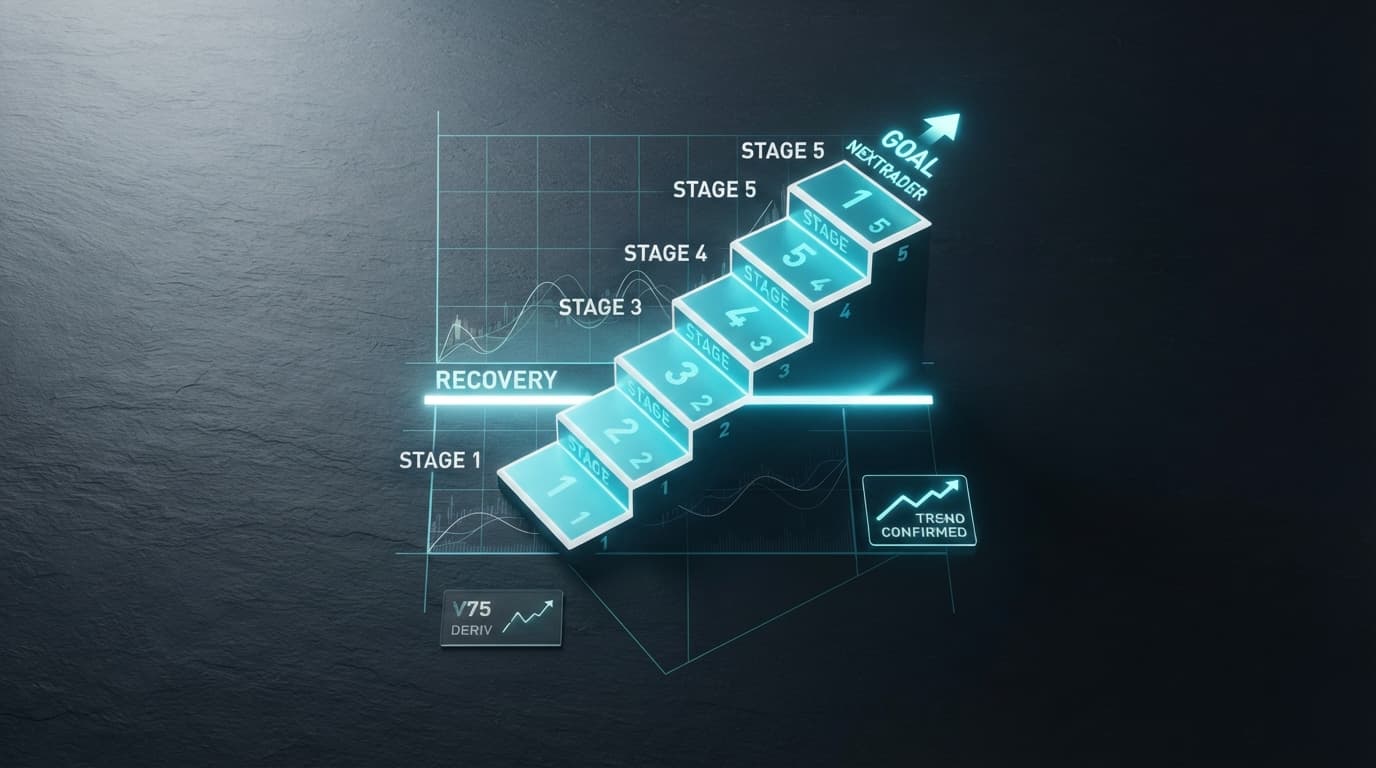
The Session, Stage by Stage
Stage 1 — Connecting the API token
We opened the web app at Nextrader App and navigated to the API Connection panel. We pasted a freshly generated Deriv API token configured with both 'Read' and 'Trade' permissions. Upon clicking Connect, the Nextrader engine established a secure WebSocket link directly to the Deriv server.
The account balance ($200.00 USD) immediately populated in the top status bar alongside real-time connection latency metrics. Unlike external BinaryBot XML scripts that run locally inside a browser tab and freeze when hidden, Nextrader maintains server-side connection persistence to ensure order execution never drops midway through an open trade setup.
Stage 2 — Selecting Strategy and Market Setup
Inside the Auto Trader interface, we clicked the market dropdown menu and selected Synthetic Indices -> Volatility 100 (1s) Index. Next, we chose the Rise/Fall contract option with a fixed duration of 5 ticks.
For trade generation, we selected the Trend Hunter AI strategy. We set the signal filter rule to require at least 4 concurring indicator signals (EMA cross, RSI momentum confirmation, MACD histogram alignment, and SuperTrend direction) on closed candles before generating an execution order. This non-repaint rule guarantees that trades trigger strictly on verified candle closes, reducing false breakout entries during low-volume consolidation cycles.
Stage 3 — Configuring Mesa Milano Parameters
With the strategy selected, we switched the Money Management tab from Fixed Stake or Martingale over to Mesa Milano. We entered the parameter values defined in our setup phase:
- Initial Stake: $2.00 USD
- Recovery Multiplier: 1.4x (instead of standard 2.0x Martingale)
- Max Recovery Steps: 4 steps
- Target Profit: $15.00 USD
- Stop Loss: $30.00 USD
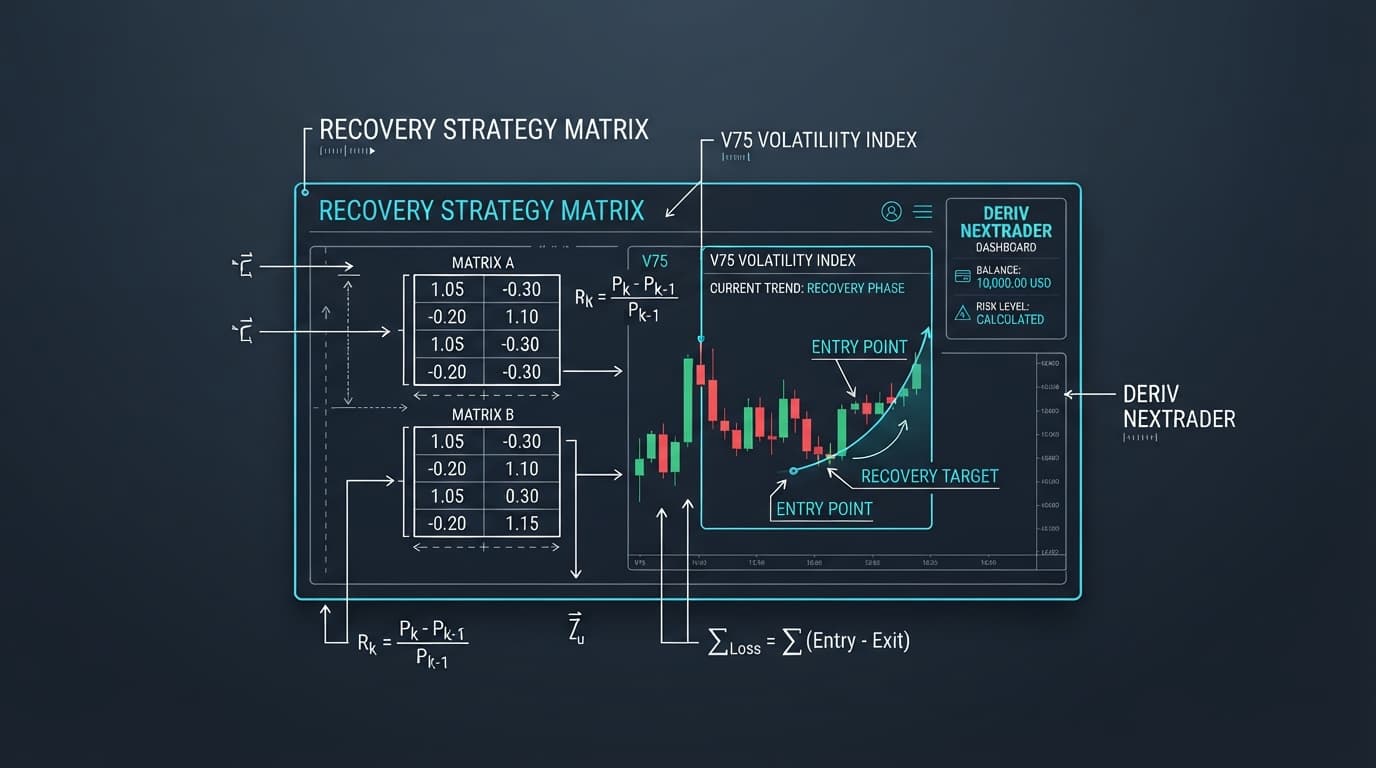
Mesa Milano instantly computed our stake ladder on screen. Instead of escalating stakes like $2 -> $4 -> $8 -> $16 ($30 total risk across 4 losses), Mesa Milano calculated a softer progression ladder: $2.00 -> $2.80 -> $3.92 -> $5.48 ($14.20 total risk across 4 losses). This configuration cut our overall exposure by more than 50% across a potential 4-trade loss streak.
Stage 4 — Initiating the Auto Trader and Experiencing Drawdown
We activated the session by clicking the green "Start Auto Trader" button. The live P&L console began streaming telemetry data in real time.
- Trade 1: High-confidence CALL signal fired. Entry price: 12450.20. Market ticked down. Result: Loss. Balance: $198.00 USD. P&L: -$2.00 USD.
- Trade 2: Reversal PUT signal fired. Mesa Milano automatically applied the 1.4x recovery step, placing a stake of $2.80 USD. Market spiked against the entry. Result: Loss. Balance: $195.20 USD. Cumulative P&L: -$4.80 USD.
- Trade 3: Continuation PUT signal fired. Mesa Milano increased the stake to $3.92 USD (Step 3). Market chopped sideways. Result: Loss. Balance: $191.28 USD. Cumulative P&L: -$8.72 USD.
At this point, three consecutive losses had occurred. Had we been running typical binary bots using aggressive double-up Martingale, our next required stake would have jumped to $16.00 USD, putting extreme pressure on our account equity. With Mesa Milano, our next calculated recovery stake was calculated at just $5.48 USD.
Stage 5 — Executing Recovery and Hitting Profit Target
With the account down -$8.72 USD, the AI strategy generated a strong multi-indicator CALL signal as momentum turned bullish on the 5-minute chart.
- Trade 4: CALL signal executed at $5.48 USD stake (Mesa Milano Step 4). Contract finished in-the-money with an 95% payout rate (+$5.21 USD net gain). Cumulative P&L updated to -$3.51 USD.
- Trade 5: Mesa Milano recognized the successful win step and adjusted the next stake to $4.20 USD to preserve locked-in gains while maintaining recovery momentum. CALL signal fired. Result: Win (+$3.99 USD net gain). Cumulative P&L moved positive to +$0.48 USD.
- Trade 6: Having fully recovered the drawdown sequence, Mesa Milano automatically reset the risk parameter back to the baseline $2.00 USD stake. A strong trend-following PUT signal executed. Result: Win (+$1.90 USD net gain).
- Trades 7–12: The strategy went on a 6-trade win streak at the base $2.00 USD stake level, bringing the cumulative session net profit to +$15.38 USD.
Upon crossing the pre-configured $15.00 USD target profit threshold, the Nextrader Auto Trader system automatically engaged its safety lock, paused execution, and logged the final session results to the console.
Reading the Results
Understanding your session metrics helps you evaluate strategy efficiency and calibrate dynamic money management settings over time. Here is what our session console revealed:
- Total Trades Executed: 12
- Wins: 9 | Losses: 3 (Win Rate: 75%)
- Max Consecutive Losses: 3
- Peak Drawdown: -$8.72 USD (4.36% of starting balance)
- Net Profit: +$15.38 USD (7.69% account gain)
The power of Mesa Milano lies in its protection during extended negative runs. If our losing streak had extended to 4 consecutive trades without a single win, Mesa Milano would have hit its maximum step safety cap (4 steps). Rather than escalating into uncontrolled high-stake trades, the algorithm triggers an automatic reset back to the base $2.00 USD stake. This deliberate reset caps your maximum drawdowns, preventing a bad streak from turning into catastrophic loss.
The Nextrader P&L console color-codes these stages so you can monitor operations clearly:
- Blue/Green highlight: Target trade entries and profitable payouts.
- Dark Red highlight: Strategy trade losses and cumulative session drawdown metrics.
- Orange highlight: Active Mesa Milano recovery step transitions.
Do This Yourself
You can replicate this disciplined risk management workflow on your own Deriv trading account without downloading scripts or writing code:
- Log in to your account management page on Deriv and generate an API token with 'Read' and 'Trade' privileges.
- Launch the free Nextrader platform by visiting Nextrader App.
- Paste your token into the API settings box to establish live WebSocket connectivity.
- Open the Auto Trader module and choose an active instrument, such as Volatility 75 (V75) or Volatility 100 (1s).
- Select an non-repainting AI trading signals model like Trend Hunter or Smart Fusion.
- Switch the Money Management module to Mesa Milano. Set your initial base stake to no more than 1% to 2% of your total account balance.
- Configure a 1.3x to 1.5x recovery multiplier, set maximum steps to 3 or 4, and define strict Target Profit and Stop Loss boundaries.
- Run the setup on a Deriv demo account first to observe how the stake progression ladder behaves under live volatility.
Start Now
Nextrader provides complete access to high-precision deriv trading tools, automated execution bots, and non-repainting ai trading signals without paywalls or subscription fees.
To launch your trading workspace, visit the main application at Nextrader App directly in your web browser. If you need to set up a new account profile, navigate to Sign Up Free — Nextrader to get started immediately.
For real-time strategy updates, custom BinaryBot XML setups, and daily market discussions with experienced synthetic index traders, join our official Telegram community at Telegram.
Trading involves risk. Past performance does not guarantee future results.