How to trade Deriv Volatility 75 index using Nextrader Telegram signals for Rise/Fall contracts step-by-step
Introduction
Welcome to this comprehensive tutorial designed to guide you through trading the popular Deriv Volatility 75 index using Nextrader's highly accurate, real-time Telegram signals for Rise/Fall contracts. Whether you're a seasoned trader looking for powerful deriv trading tools or a newcomer eager to leverage cutting-edge AI-driven insights, this guide is for you. By the end of this tutorial, you will be able to confidently interpret Nextrader's signals, execute precise Rise/Fall trades on Deriv, and apply sound risk management principles to enhance your trading journey. We'll demystify the process, ensuring you can harness the power of Nextrader's intelligent signals to make informed trading decisions.
This tutorial focuses specifically on the Volatility 75 index, a highly liquid synthetic index on Deriv, known for its consistent volatility, making it a favorite among traders. We'll walk you through everything from understanding the signal structure to placing your trade and monitoring its performance.
Nextrader (nextrader.live) provides 100% free, non-repaint trading signals, ensuring that what you see is what you get, as signals only fire on CLOSED candles when a minimum of 3-4 indicators agree. This robust methodology, powered by 11 named AI strategies like Trend Hunter (EMA crossover), Reversal Radar (RSI), and Smart Signals (requiring 4+ indicators to agree), delivers high-confidence trading opportunities across various markets and timeframes.
What You Need Before Starting
Before diving into the trading process, ensure you have the following essentials:
Get Live AI Trading Signals
Real-time non-repaint signals powered by 11 professional AI strategies. Volatility Indices, Forex, Gold & Crypto — no subscription, no paywall.
- Auto Trader Bot
- Digit Trader Bot
- 11 AI Strategies
- Live Telegram Signals
- An active Deriv.com account: This can be a real or demo account. We highly recommend starting with a demo account to practice.
- A Nextrader account: Sign up for free at app.nextrader.live/signup. No subscriptions, no paywalls – all features are unlocked.
- Access to the Nextrader Telegram channel: Join t.me/nextraderlive to receive real-time signals.
- Basic understanding of Rise/Fall contracts: Familiarity with how these contracts work on Deriv will be beneficial.
Step 1: Subscribing to Nextrader Telegram Signals and Identifying V75
The first crucial step is to gain access to Nextrader's powerful, real-time trading signals. These signals are delivered directly to your Telegram, making them accessible on the go.
1. Join the Official Nextrader Telegram Channel: Navigate to t.me/nextraderlive and join the channel. This is where you'll receive up to 30 signals per day across 30 markets, delivered every 5 minutes.
2. Monitor for Volatility 75 Signals: Once joined, you'll start seeing a stream of signals. Each signal will clearly state the market, timeframe, direction (Rise/Fall), entry price, and recommended Stop Loss (SL) and Take Profit (TP1, TP2) levels, along with a confidence level. For this tutorial, you need to identify signals specifically for Volatility 75 Index (V75).
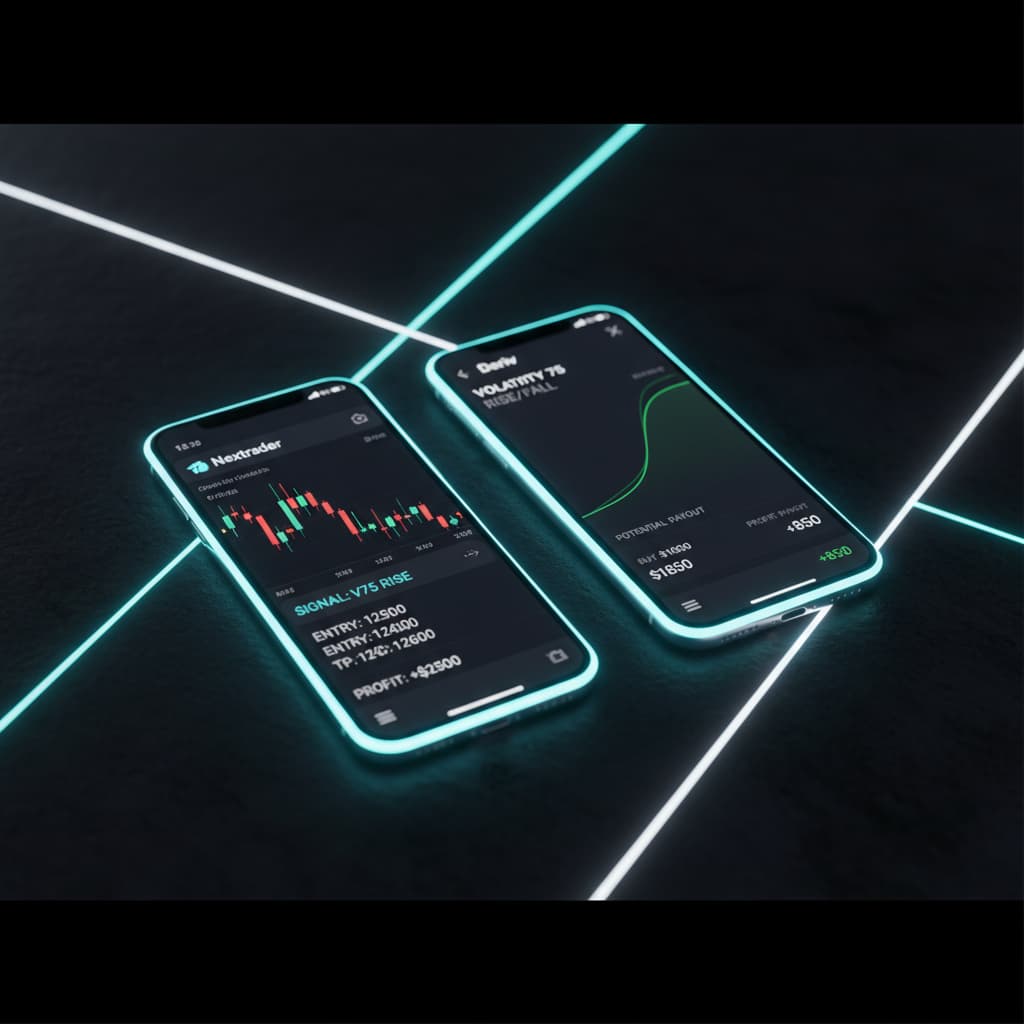
* Example signal structure: V75 (10min) - RISE @ 12345.67 - SL: 12300.00 - TP1: 12400.00 - TP2: 12450.00 - Confidence: 78%
3. Understand Signal Reliability: Nextrader's signals are non-repaint, meaning they don't change after they've been issued. They only fire on CLOSED candles, ensuring that the market conditions that triggered the signal are confirmed. This reliability is a cornerstone of Nextrader's deriv trading tools, preventing false signals that can plague other platforms. The signals are generated when a minimum of 3-4 indicators agree, often leveraging advanced AI strategies like Smart Signals or Smart Fusion for multi-indicator consensus, giving you a strong edge.
Step 2: Interpreting V75 Rise/Fall Signals and Their Parameters
Once you've spotted a Volatility 75 signal in the Nextrader Telegram channel, it's essential to understand each component to execute your trade effectively.
1. Market and Timeframe: The signal will always specify V75 and a timeframe (e.g., 5min, 10min, 30min, 1 hour). The timeframe indicates the expected duration or validity of the signal. A 5-minute signal suggests a shorter-term move, while a 1-hour signal points to a longer-term trend. This helps you choose the appropriate duration for your Rise/Fall contract on Deriv.
2. Direction (RISE/FALL): This is the core of your trade. If the signal says RISE, you will predict the price will go higher than your entry point. If it says FALL, you predict it will go lower. These are the two options for Deriv's Rise/Fall contracts.
3. Entry Price: This is the ideal price point at which to enter the trade. Aim to execute your trade on Deriv as close to this price as possible. Small deviations are common in fast-moving markets, but significant differences might reduce the signal's effectiveness.
4. Confidence Level (30-85%): This percentage indicates the strength and probability of the signal's success. Higher confidence levels (e.g., 75% or 80%+) suggest a stronger likelihood of the predicted movement. These robust signals are often generated by Nextrader's sophisticated AI strategies like Momentum Wave (MACD) or Trend Rider (SuperTrend), or even the powerful Smart Signals, which require multiple indicators to agree. Prioritize signals with higher confidence, especially when starting out.
5. Stop Loss (SL) and Take Profit (TP1, TP2): While Deriv's standard Rise/Fall contracts don't have built-in SL/TP features in the same way spot trading does, these values are critical guidelines.
* Stop Loss (SL): This is the price point where, if the market reaches it, the signal is considered invalidated, and you would typically exit a trade to limit losses. For Rise/Fall, this means if the price moves significantly against your prediction and hits the SL level, you might choose to avoid entering, or if you've already entered, consider it a sign that the trade is unlikely to succeed.
* Take Profit (TP1, TP2): These are target price levels where you would consider closing a profitable trade. For Rise/Fall, if the price moves favorably towards TP1 or TP2 and you're nearing the end of your contract duration, it reinforces the signal's accuracy. These levels help you gauge the potential upside.
Step 3: Executing the Rise/Fall Trade on Deriv
With your Nextrader signal understood, it's time to place your trade on the Deriv platform.
1. Log in to Deriv: Access your Deriv.com account (app.deriv.com) either via your web browser or the mobile app.
2. Select the Market: On the Deriv trading interface, navigate to the market selection.
* Choose "Deriv" as the platform.
* Then select "Volatility Indices".
* Finally, select "Volatility 75 Index" from the list.
3. Choose Trade Type: Under the trade type options, select "Rise/Fall". This is the specific contract type we are targeting with Nextrader's signals.
4. Set Duration: Based on the timeframe indicated in the Nextrader Telegram signal (e.g., 5min, 10min), set the corresponding duration for your Deriv contract. If the signal is for 10min, set your duration to 10 minutes or a slightly shorter period to allow for entry.
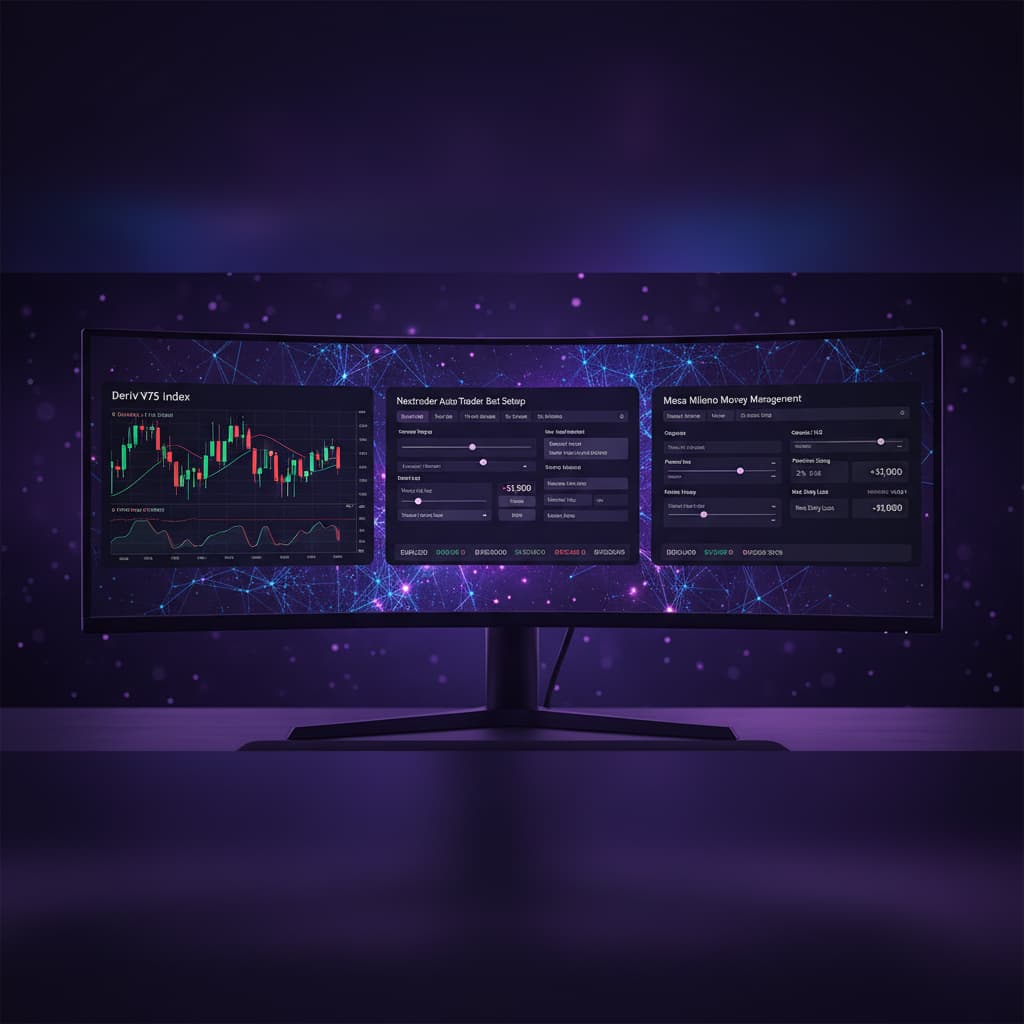
5. Input Stake: Carefully enter the amount you wish to stake on the trade. Remember your money management rules. For beginners, a fixed, small stake is highly recommended. Nextrader's Auto Trader Bot offers advanced money management options like Fixed Stake, Martingale, and Mesa Milano (smart loss recovery) for automated trading, but for manual trades, sticking to a predetermined fixed stake is crucial.
6. Compare Entry Price and Place Trade: Observe the current market price on Deriv. Compare it to the Entry Price provided in the Nextrader signal.
* If the signal is RISE and the current Deriv price is at or slightly below the signal's entry price, click the "Rise" button.
* If the signal is FALL and the current Deriv price is at or slightly above the signal's entry price, click the "Fall" button.
* Aim to enter as close to the signal's entry price as possible for optimal results. Nextrader's signals are generated by robust deriv trading tools, but execution timing is still key.
Step 4: Monitoring Your Trade and Managing Risk
Once your Rise/Fall contract is active on Deriv, monitoring and risk management become paramount, even with fixed-duration contracts.
1. Track on Deriv: Your active trade will appear in the "Portfolio" or "Open Positions" section of your Deriv account. You can see its progress, whether it's currently in profit or loss, and the time remaining until expiry.
2. Utilize Nextrader's Console (Optional but Recommended): If you also have the Nextrader web application (app.nextrader.live) open, you can link your Deriv account via Deriv WebSocket API integration (App ID 67545). This allows you to use Nextrader's multi-account support and real-time color-coded trading console to track your live P&L for all your accounts in one place, even for trades placed manually from Telegram signals. This provides an additional layer of oversight and a more holistic view of your trading performance across different deriv bots and manual trades.
3. Consider SL/TP as Manual Guidelines: As mentioned, Rise/Fall contracts don't have automatic Stop Loss or Take Profit. However, the SL and TP levels provided by Nextrader are invaluable for manual decision-making.
If the price moves significantly against your predicted direction and approaches the signal's SL level before* expiry, it indicates a high probability that the trade will not be successful. While you can't exit early on a standard Rise/Fall contract, this insight helps you understand why a trade might fail and informs your future entries.
* Conversely, if the price moves strongly in your favor towards TP1 or TP2, it reinforces the signal's accuracy and gives you confidence in the strategy.
4. Adhere to Money Management: Regardless of the signal's confidence, never over-stake. Stick to a predetermined percentage of your capital per trade. For example, risk no more than 1-2% of your account balance on any single trade. This disciplined approach, similar to the Fixed Stake option in Nextrader's Auto Trader Bot, is crucial for long-term survival in the markets.
Step 5: Reviewing Performance and Adapting Your Strategy
After your Rise/Fall contract expires on Deriv, it's vital to review the outcome and learn from each trade to refine your approach.
1. Review Trade Outcome: Check your Deriv statement or portfolio to see if your V75 trade resulted in a win or a loss. Note the actual entry and exit prices.
2. Compare with Signal: Compare the outcome with the Nextrader Telegram signal's prediction, especially considering the confidence level, entry price, and SL/TP guidance. Did a high-confidence signal lead to a win? Did a lower-confidence signal surprise you?
3. Maintain a Trading Journal: Keep a record of your trades. This could be a simple spreadsheet noting the date, time, V75 market, signal direction, entry price, actual outcome, profit/loss, and the signal's confidence level. This journal is a powerful deriv trading tool for identifying patterns in your trading and the signals.
4. Leverage Nextrader Analytics: While the Telegram provides signals, the Nextrader platform itself offers live P&L tracking and performance metrics for trades executed through its deriv bots. Even for manual trades, understanding the overall success rate of V75 signals from the Telegram can inform your strategy. This data can help you identify which timeframes or confidence levels yield the best results for you.
5. Consider Automation: Once you're comfortable with manual trading, explore Nextrader's Auto Trader Bot. This powerful feature can automate Rise/Fall and Higher/Lower contracts directly on Deriv, using advanced money management strategies like Fixed Stake, Martingale, or Mesa Milano. It transforms manual deriv trading tools into efficient deriv bots, allowing you to scale your trading without constant manual intervention. Similarly, the Digit Trader Bot offers AI last-digit prediction, another advanced automation for specific Deriv contracts.
Pro Tips
1. Prioritize High-Confidence Signals: Always lean towards signals with higher confidence levels (e.g., 70% or more). These signals often stem from Nextrader's most sophisticated AI strategies like Smart Signals or Cloud Walker (Ichimoku), where multiple indicators rigorously agree, offering a stronger probability of success.
2. Practice on Demo Accounts Religiously: Before deploying real capital, use your Deriv demo account extensively. This allows you to get comfortable with the signal interpretation and execution process without financial risk, ensuring you master the use of these deriv trading tools.
3. Implement Robust Money Management: Even with Nextrader's precise signals, never risk more than a small, fixed percentage of your total trading capital per trade. While Nextrader's Auto Trader Bot offers advanced options like Martingale and Mesa Milano, for manual trading, a simple Fixed Stake approach is the safest bet to protect your capital over the long term.
4. Explore the Full Nextrader Ecosystem: Beyond Telegram signals, the Nextrader platform (app.nextrader.live) offers a complete suite of deriv trading tools. This includes the Auto Trader Bot for automating Rise/Fall contracts, the Digit Trader Bot for AI last-digit prediction (DIGITEVEN/ODD/OVER/UNDER/MATCH/DIFF), and 11 named AI strategies like Reversal Radar (RSI) and Volatility Pulse (Bollinger Bands). Integrating these features can significantly enhance your trading efficiency and diversify your strategies.
Start Trading Now
Ready to elevate your Deriv Volatility 75 trading? Join the Nextrader community and start leveraging intelligent, real-time signals today.
Sign up for your free Nextrader account at Sign Up Free — Nextrader or access the platform directly at Nextrader App
Don't miss out on real-time signals – join our Telegram channel at t.me/nextraderlive.
Trading involves risk. Past performance does not guarantee future results.