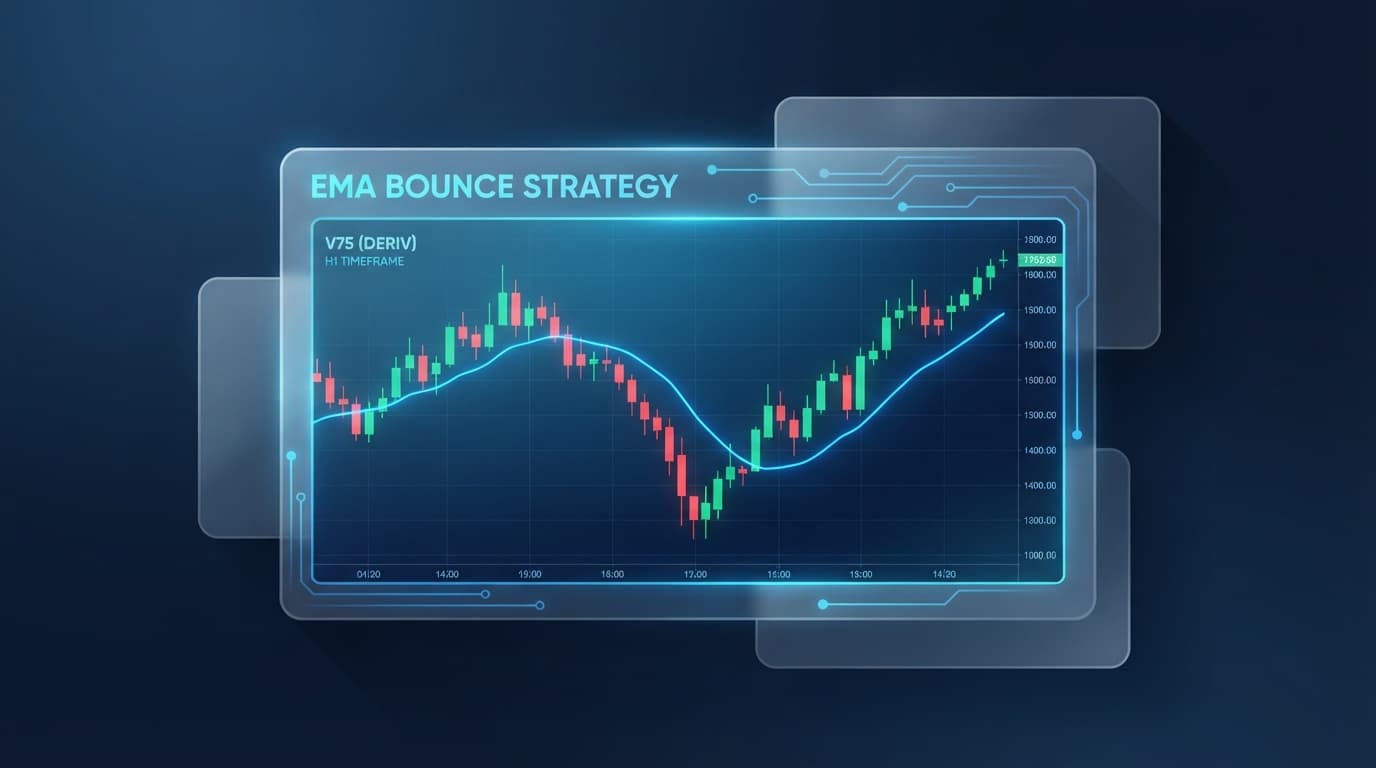

An h4 trend filter is a rule-based directional boundary calculated from the 4-hour 50-period Exponential Moving Average (EMA50) that restricts lower-timeframe trade execution strictly to higher-timeframe momentum. Lower-timeframe triggers operating on 1-minute to 30-minute charts generate high signal frequency, but frequently fail when trading directly into higher-timeframe support or resistance. By establishing a 4-hour structural filter, traders ensure lower-timeframe momentum, volatility, and candle pattern setups align with macro market flow.
Lower-timeframe execution models operating on 1-minute to 30-minute charts generate high signal density, but they suffer from frequent false breakouts when trading into strong higher-timeframe resistance or support. Incorporating an H4 50-period Exponential Moving Average (EMA) context filter acts as an operational boundary. Instead of forcing traders to predict macro turning points, the H4 EMA filter establishes a rigid set of rules that eliminates entries directly contesting higher-timeframe momentum.
At Nextrader, we integrate these directional boundaries across our suite of deriv trading tools, combining higher-timeframe structural discipline with real-time automated execution. By applying an asymmetrical exclusion engine, traders eliminate low-probability signals without sacrificing valid consolidation breakouts or early structural shifts.
Structuring the H4 Trend Filter: Directional Rules for Gold, AUD/JPY, and Crypto
Standard trend-following filters use binary rules: buy only when price sits above an indicator, and sell only when price sits below it. In practice, this rigid model fails during market transitions, blocking valid lower-timeframe range breakouts and momentum turns during broad higher-timeframe consolidation. The H4 50 EMA structural model instead enforces an asymmetrical exclusion rule.
Get Live AI Trading Signals
Real-time non-repaint signals from 11 AI strategies — Volatility Indices, Forex, Gold & Crypto. No subscription, no paywall.
- Auto Trader Bot
- Digit Trader Bot
- 11 AI Strategies
- Live Telegram Signals
Under asymmetrical exclusion, a trade setup is disqualified only when the H4 market structure actively opposes the trade direction.
- Price above H4 EMA50: Long setups are permitted; neutral or range-bound setups are permitted; short setups are strictly blocked.
- Price below H4 EMA50: Short setups are permitted; neutral or range-bound setups are permitted; long setups are strictly blocked.
- Slope evaluation: When price action fluctuates around the 50 EMA with flat slope metrics, counter-trend restrictions soften, allowing range-bound lower-timeframe triggers to execute.
Asset-Specific Execution Setup Rules
Different asset classes demand tailored lower-timeframe triggers beneath the H4 trend filter umbrella. Applying identical entry parameters across metals, forex, and cryptocurrency leads to severe slippage and degraded expectancy.
#### 1. Gold (XAUUSD, M30 Timeframe)
Gold trades respond aggressively to session liquidity spikes and multi-hour range expansions. On the 30-minute chart, Gold setups evaluate four primary trigger mechanisms:
- London Asian Range Breakout: Executes when price breaks the high or low of the Asian consolidation session during the London open (07:00 UTC onward), provided the breakout aligns with or is neutral to the H4 EMA50.
- 20-Hour High/Low Breakout: Triggers on structural breaks of the rolling 20-hour price envelope.
- EMA20 Pullback: Capitalizes on gentle trend retests of the 30-minute 20-period EMA.
- RSI(2) Dip: Identifies extreme short-term oversold (below 10) or overbought (above 90) conditions within the established flow.
Gold signals operate between 07:00 and 20:00 UTC, Monday through Friday, with all trades closed by Friday 20:00 UTC to prevent weekend gap exposure.
#### 2. AUD/JPY (H1 Timeframe)
Cross-forex pairs like AUD/JPY exhibit heavy momentum continuation following range breaks. On the 1-hour timeframe, setups are strictly restricted to range breakouts. Pullbacks and mean-reversion signals are ignored to prevent getting trapped inside choppy Asian session ranges. A valid H1 AUD/JPY breakout setup fires only when the direction matches the H4 50 EMA bias.
#### 3. BTC/USD (M30 Timeframe)
Bitcoin price action is characterized by deep, aggressive retracements within dominant macro trends. Consequently, BTC/USD M30 setups ignore raw breakout triggers entirely—which frequently turn into bull or bear traps—and focus exclusively on RSI(2) dip pullbacks. A buy signal requires price to be above the H4 50 EMA while the M30 RSI(2) prints an extreme oversold reading below 10. BTC/USD setups operate 7 days a week without weekend session closes.
Volatility-Based Risk Engine: H1 ATR Multiples
Fixed-pip stop losses fail because market volatility expands and contracts dynamically. To ensure structural protection, stop-loss distances are derived using Average True Range (ATR) calculated on the 1-hour chart:
- Gold (XAUUSD): 2.5 × H1 ATR. Gold requires wider breath due to institutional liquidity sweeps.
- AUD/JPY: 1.5 × H1 ATR. Fits standard currency pair volatility envelopes.
- BTC/USD: 1.5 × H1 ATR. Accounts for crypto volatility while protecting against structural breakdowns.
Executing H4 Filtered Setups with Nextrader AI Signals and Deriv Tools
Implementing systematic higher-timeframe filters manually across multiple charts requires non-stop screen monitoring. By combining automated scanning with precise trade panels, traders systematically execute setups that align with the H4 EMA50 trend filter.
On the Nextrader App, live market scanning continuously analyzes Deriv synthetic indices (V10, V25, V50, V75, V100, plus 1Hz variants), forex, commodities, and crypto across 1m, 5m, 15m, and 1h closed candles. Because evaluation occurs exclusively on non-repainting closed candles, triggers remain stable.
- 1 Scan live market signal cards on the Nextrader App
- 2 Verify signal direction against 4-hour EMA50 structural alignment
- 3 Open signal confirmation window to review suggested stake and risk-reward
- 4 Execute position via Quick Trade panel with pre-filled Stop Loss and Take Profit
Filtered Signal Execution in the Nextrader App
Signal cards generated on the Nextrader App display direction (UP/DOWN), signal strength, timeframe, confluence percentage, and the underlying technical drivers. Multi-indicator algorithms like Smart Signals (requiring 4 or more concurring technical indicators) or Trend Hunter evaluate lower-timeframe price structure against market momentum.
Clicking an active signal card opens a trade confirmation window with pre-filled parameters. Traders executing via the Quick Trade panel can trade Multipliers (e.g. x100) or Rise/Fall contracts. The panel automatically populates Stop Loss and Take Profit levels calculated directly from current market volatility, ensuring lower-timeframe execution stays protected by structural risk barriers.
Rule-Based Automation with Nextrader Auto Trader
For traders seeking automated execution on Deriv synthetic indices, the Nextrader Auto Trader runs tick-based Rise/Fall or Accumulator modes (1% to 5% growth rate). The Auto Trader evaluates tick directional confidence while enforcing strict money management limits.
Traders set a base stake alongside mandatory Win Targets and Loss Limits to ensure execution halts automatically upon reaching structural thresholds. Risk models include Fixed Stake, Martingale (doubles stake after loss; high risk), or Mesa-Milano stake scaling. Built-in Auto-Sell features on Accumulator contracts provide immediate risk mitigation if price approaches outer barrier boundaries.
How the H4 Filter Drives NexTrader Telegram Signals
Higher-timeframe filtering is equally central to our free forex, gold, and crypto signals published via Telegram (t.me/nextrader_signals). This dedicated signal stream issues lot-based CFD price levels for Gold (M30), AUD/JPY (H1), and BTC/USD (M30). Every trade issued by the engine enforces the H4 EMA50 trend filter, blocking long signals during H4 downtrends and short signals during H4 uptrends.
Traders can inspect every filtered outcome—including full history and lot calculators—on our public dashboard at telegram-signals.nextrader.live. Combining systematic deriv trading signals with an asymmetrical H4 trend filter establishes a repeatable, disciplined workflow designed to eliminate counter-trend bias and protect capital.
Master Professional Market Analysis
Ready to eliminate counter-trend guesswork and trade with automated structural filters?
- Access high-confluence signal engines and real-time execution tools on the Nextrader App.
- Create your free account today at Nextrader Signup.
- Join thousands of active synthetic indices and forex traders in our official Telegram community at Telegram.
Trading involves risk. Past performance does not guarantee future results.