
Introduction
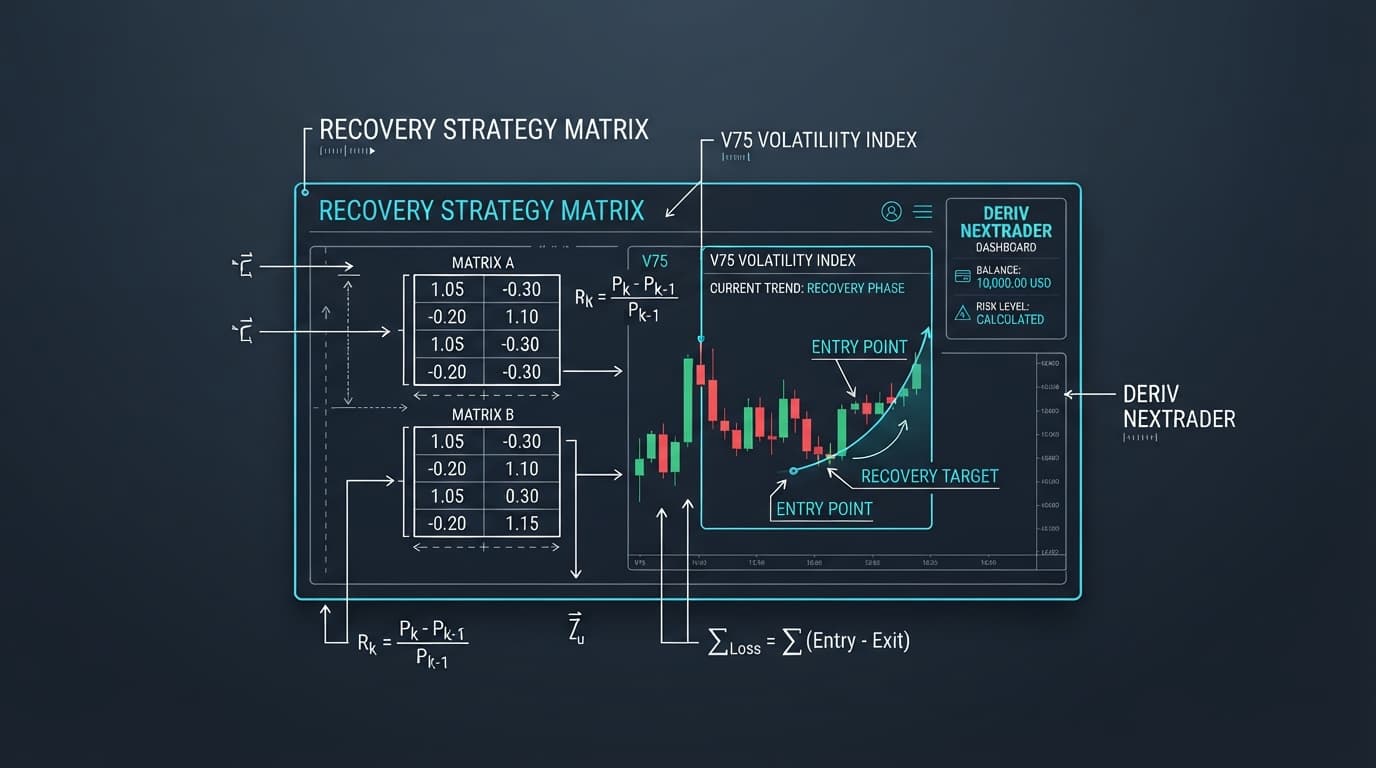
Welcome to this in-depth tutorial from Nextrader, your go-to platform for powerful, 100% free trading tools. In the dynamic world of online trading, especially with high-volatility assets like Deriv's Volatility Indices, effective risk management and a robust loss recovery strategy are paramount. This guide is designed for traders who want to leverage the advanced capabilities of Nextrader's Auto Trader Bot to navigate market fluctuations, mitigate potential losses, and systematically recover capital using the intelligent Mesa Milano money management system.
By the end of this tutorial, you will possess the knowledge and practical steps to configure your Nextrader Auto Trader Bot, connect it to your Deriv account, and strategically deploy the Mesa Milano algorithm to manage your trading capital on Volatility Indices. You'll learn how to automate your trades, harness sophisticated AI-driven signals, and implement a smart loss recovery mechanism that goes beyond traditional methods, empowering you to trade with greater confidence and control.
Nextrader provides a comprehensive suite of deriv trading tools, including powerful deriv bots and binary bots designed for precision and automation. Our platform ensures that all features are unlocked and free, enabling you to access professional-grade trading technology without any subscriptions or paywalls. This tutorial will focus on maximizing these tools for a structured approach to risk and reward on Deriv's unique synthetic markets.
What You Need Before Starting
- Deriv.com Account: A verified and funded Deriv account (preferably a live account, but a demo account is excellent for practice).
- Nextrader.live Account: A free Nextrader account. If you don't have one, you can sign up easily at Sign Up Free — Nextrader.
- Basic Understanding of Volatility Indices: Familiarity with how Deriv's Volatility Indices (V10, V25, V50, V75, V100, 1Hz) behave.
- Stable Internet Connection: Essential for uninterrupted bot operation and real-time signal reception.
Step 1: Connecting Your Nextrader Account to Deriv and Selecting Your Market
The first step to automating your trading with Nextrader's powerful deriv bots is to establish a secure connection with your Deriv account and select the Volatility Index you wish to trade.
Get Live AI Trading Signals
Real-time non-repaint signals from 11 AI strategies — Volatility Indices, Forex, Gold & Crypto. No subscription, no paywall.
- Auto Trader Bot
- Digit Trader Bot
- 11 AI Strategies
- Live Telegram Signals
- Log in to Nextrader: Go to Nextrader App and log in to your Nextrader account. If you're new, quickly sign up – it's completely free.
- Navigate to Account Settings: Once logged in, look for the "Account" or "Settings" section, typically found in the dashboard's sidebar or top menu.
- Connect Deriv Account: Within the account settings, you'll find an option to "Connect Deriv Account." Click this. Nextrader uses the Deriv WebSocket API (App ID 67545) for seamless and secure integration. You will be prompted to log in to your Deriv account or grant permissions if already logged in. Nextrader supports multi-account functionality, allowing you to connect multiple Deriv accounts (demo or real) and switch between them effortlessly.
- Select Trading Account: After successful connection, return to your Nextrader dashboard. In the top-right corner, you'll see a dropdown menu displaying your connected Deriv accounts. Select the specific Deriv account (e.g., your real Volatility Indices account) you intend to use for this strategy.
- Choose Your Volatility Index: Now, navigate to the "Auto Trader Bot" section from the main menu. On the bot configuration interface, locate the "Market" dropdown. Here, you'll find a comprehensive list of available markets. For this tutorial, select your preferred Volatility Index, such as "Volatility 100 Index," "Volatility 75 Index," or any other that aligns with your trading preference. Nextrader's binary bots are optimized for these markets.
Step 2: Configuring the Auto Trader Bot's Core Settings
With your Deriv account connected and market selected, the next crucial step is to define the fundamental trading parameters for your Auto Trader Bot. These settings dictate how the bot interacts with the market based on Nextrader's real-time non-repaint trading signals.
- Access Auto Trader Bot: Ensure you are in the "Auto Trader Bot" section of the Nextrader platform.
- Select Contract Type: Under the "Contract Type" option, choose either "Rise/Fall" or "Higher/Lower." These are common contract types for binary options on Deriv. For Volatility Indices, "Rise/Fall" is generally a good starting point as it simply predicts if the price will be above or below the entry point at expiry.
- Set Duration: Define your "Duration" for each trade. This can be set in "Ticks" or "Minutes." For scalping strategies on Volatility Indices, 5-10 ticks or 1-2 minutes are common. Experiment with what suits your chosen Volatility Index and signal timeframe. Remember that shorter durations mean faster trades and potentially more signals.
- Choose Signal Timeframe: This is critical for the bot's signal generation. Nextrader offers signals on 4 timeframes: 5min, 10min, 30min, and 1 hour. Select the timeframe that best aligns with your trading style and the volatility of your chosen index. For instance, a 5min timeframe will generate more frequent signals based on shorter-term market movements, while a 30min or 1-hour timeframe will focus on broader trends. Nextrader's signals are highly reliable as they only fire on CLOSED candles, requiring a minimum of 3-4 indicators to agree, ensuring non-repaint accuracy.
- Initial Stake: Set your "Initial Stake." This is the base amount your bot will use for its first trade in a new sequence or after a successful recovery. Start with a very small amount, especially when testing new strategies or markets. This is a foundational element for the Mesa Milano strategy.
Step 3: Activating Mesa Milano for Smart Loss Recovery
This is the core of our strategy: implementing Nextrader's innovative Mesa Milano money management system. Unlike a simple Martingale, Mesa Milano is a smart loss recovery mechanism designed to recover losses efficiently while managing risk.
- Navigate to Money Management: Within the Auto Trader Bot configuration, locate the "Money Management" section.
- Select Mesa Milano: From the dropdown options (which include Fixed Stake and Martingale), choose "Mesa Milano."
- Understand Mesa Milano Parameters:
* Initial Stake: (Already set in Step 2) This is your base trade amount.
* Max Loss Recovery Steps: This is a crucial risk control parameter. It defines the maximum number of consecutive loss recovery trades Mesa Milano will attempt before resetting. For example, if set to 3, the bot will try to recover losses for up to three consecutive losing trades. Setting a reasonable limit here prevents excessive capital exposure during prolonged losing streaks.
* Profit Target After Recovery: This parameter allows you to define a specific profit amount that, once achieved after a loss recovery sequence, will reset the stake back to the initial stake. This prevents over-leveraging after a successful recovery and helps in securing profits. For instance, if set to $1, after a series of recovery trades, once the net profit for that sequence reaches $1, the bot will revert to the initial stake for the next signal.
- Why Mesa Milano? Mesa Milano intelligently adjusts the stake size after a loss, aiming to recover the previous loss plus a small profit, but it does so with a calculated approach, respecting the "Max Loss Recovery Steps" and "Profit Target After Recovery." This makes it a more sophisticated deriv trading tool than a basic Martingale, which can quickly lead to substantial capital depletion during extended drawdowns. It's designed to be a "smart loss recovery" system, giving you more control over your risk exposure.
- Start Small: Reiterate the importance of starting with a minimal initial stake when using Mesa Milano, especially on volatile markets. This allows you to observe its behavior and fine-tune parameters without significant capital risk.
Step 4: Selecting and Customizing AI Strategies for Signal Generation
Nextrader's strength lies in its diverse range of AI-powered strategies that generate real-time, non-repaint trading signals. For your Auto Trader Bot to function effectively with Mesa Milano, you need to select the AI strategy that will provide the trading direction.
- Choose an AI Strategy: In the Auto Trader Bot interface, locate the "AI Strategy" dropdown. Nextrader offers 11 named AI strategies, each leveraging different indicators and market approaches:
* Trend Hunter (EMA crossover): Ideal for capturing trending markets.
* Reversal Radar (RSI): Focuses on identifying potential market reversals.
* Momentum Wave (MACD): Tracks momentum shifts.
* Volatility Pulse (Bollinger Bands): Excellent for range-bound markets or breakout detection.
* Swift Scalper (Stochastic RSI): Designed for quick, short-term trades.
* Trend Rider (SuperTrend): A robust trend-following indicator.
* Cloud Walker (Ichimoku): Provides comprehensive trend and support/resistance insights.
* Price Magnet (VWAP): Utilizes volume-weighted average price for entry/exit.
* Breakout Beast (ATR): Identifies potential breakouts based on volatility.
* Smart Fusion (multi-indicator): Combines several indicators for enhanced signal quality.
* Smart Signals (4+ indicators): This is often a robust choice as it requires a minimum of 4 indicators to agree, providing high-confidence signals.
- Consider Confidence Levels: Nextrader provides a "Confidence Level" for each signal, ranging from 30% to 85%. You can set a "Minimum Confidence" threshold for the bot to accept a signal. For example, setting it to 70% means the bot will only execute trades when the AI strategy generates a signal with 70% confidence or higher, filtering out weaker signals.
- Understand Signal Output: While the Auto Trader Bot automates entry based on the signal direction, Nextrader also provides "Entry price," "Stop Loss," and "Take Profit 1 & 2" for each signal. These are invaluable for manual traders or for understanding the potential risk/reward of the bot's entries. The bot uses the signal direction (Rise/Fall, Higher/Lower) to execute the trade.
- Experiment and Observe: Different Volatility Indices and market conditions might respond better to specific AI strategies. Start with a widely applicable strategy like "Smart Signals" or "Trend Hunter," observe its performance with Mesa Milano, and then experiment with others. This iterative process is key to optimizing your deriv trading tools.
Step 5: Monitoring Performance and Adjusting Mesa Milano Settings
Once your Nextrader Auto Trader Bot is configured with Mesa Milano and your chosen AI strategy, the final step is to activate it, diligently monitor its performance, and be prepared to make informed adjustments.
- Start the Bot: After reviewing all your settings, click the "Start Bot" button. The bot will begin listening for signals based on your chosen AI strategy, timeframe, and minimum confidence level.
- Real-time Trading Console: Nextrader features a real-time color-coded trading console. This console will display every trade executed by your bot, showing the market, contract type, stake, result (win/loss), and profit/loss. The color-coding (e.g., green for wins, red for losses) provides an immediate visual cue of performance.
- Live P&L Tracking: Closely monitor the "Live P&L" (Profit & Loss) tracking feature on your dashboard. This provides an aggregated view of your bot's overall performance. You'll see how Mesa Milano activates after losses, increasing the stake to recover, and then resets after a successful recovery or reaching the profit target.
- Interpreting Mesa Milano's Actions: Pay attention to how Mesa Milano manages consecutive losses. You'll observe the stake increasing incrementally until a recovery trade is won or the "Max Loss Recovery Steps" limit is reached. If the limit is reached, the bot will reset to the initial stake for the next signal, protecting your capital from unlimited escalation.
- When to Adjust: Market conditions on Volatility Indices can change rapidly.
* Prolonged Drawdowns: If your bot experiences a long losing streak, even with Mesa Milano, consider pausing the bot. Re-evaluate your chosen AI strategy, signal timeframe, or even the market itself. Sometimes, switching from a trend-following strategy to a reversal one (e.g., from Trend Hunter to Reversal Radar) might be necessary.
* Stake Size: If your initial stake feels too high or too low, adjust it. Mesa Milano works best when the initial stake is small relative to your total capital.
* Max Loss Recovery Steps: If you find the bot hitting the max steps too frequently, you might either need to re-evaluate your strategy/market or consider if your risk tolerance allows for more steps (though this increases risk). Conversely, if you want tighter risk control, reduce the steps.
* Profit Target After Recovery: Adjust this to balance quicker resets with maximizing recovery profits.
- Don't Leave Unsupervised Indefinitely: While Nextrader's deriv bots automate trading, active monitoring, especially when using loss recovery systems, is crucial. Regularly check the bot's performance and be ready to intervene if market conditions become unfavorable.
Pro Tips
- Diversify Your Markets and Strategies: Don't put all your eggs in one basket. With Nextrader's multi-account support, you can run different Auto Trader Bots simultaneously on various Volatility Indices (e.g., V100, V75) or even Forex, Gold, or Crypto markets. You could even use different AI strategies on each, spreading your risk and increasing opportunities.
- Leverage Multiple Timeframes: Experiment with running the Auto Trader Bot on different signal timeframes (5min, 10min, 30min, 1 hour) for the same Volatility Index. This can help you catch both short-term scalping opportunities and longer-term trends, providing a more holistic approach to market engagement.
- Utilize Telegram Signals for External Validation: Nextrader offers real-time signals via Telegram for 30 markets, every 5 minutes, with up to 30 signals per day. Use these signals as an extra layer of confirmation for your bot's chosen strategy or even for manual trading alongside your automated setup. They serve as excellent deriv trading tools for market insights.
- Practice on Deriv Demo Account First: Before deploying any strategy, especially one involving loss recovery like Mesa Milano, always test it thoroughly on a Deriv demo account. This allows you to fine-tune your settings, understand the bot's behavior, and gain confidence without risking real capital.
Start Trading Now
Ready to take control of your trading on Deriv Volatility Indices with Nextrader's advanced deriv bots and smart loss recovery? Head over to Nextrader App to log in or Sign Up Free — Nextrader to sign up for your free account today. For real-time signals and community insights, join our Telegram channel at Telegram.
Trading involves risk. Past performance does not guarantee future results.