
Introduction
Welcome to this comprehensive tutorial designed for traders looking to elevate their Deriv trading experience through automation. In this guide, we'll walk you through the precise steps to automate your Deriv V75 Higher/Lower contracts using Nextrader's powerful Auto Trader Bot, specifically leveraging the intelligent Mesa Milano money management strategy. This tutorial is perfect for both new and experienced traders who want to free up time, reduce emotional trading, and implement a disciplined approach to volatility index trading. By the end, you'll have a fully configured trading bot running on Nextrader, executing trades on your behalf on the V75 market with advanced loss recovery.
Nextrader is a revolutionary platform offering 100% free, no-subscription access to advanced trading signals and automation tools. Our real-time, non-repaint signals are generated when a minimum of 3-4 indicators agree, ensuring high-quality entry points across various timeframes and markets. With Nextrader, you gain access to sophisticated deriv trading tools that can transform your approach to the markets.
What You Need Before Starting
- A Deriv Account: You'll need an active Deriv.com account (demo or real) to connect to Nextrader.
- A Nextrader Account: Register for a free account at Sign Up Free — Nextrader.
- Basic Understanding of V75: Familiarity with Volatility 75 Index (V75) and Higher/Lower contracts on Deriv is beneficial.
- Deriv API Token: You'll need to generate an API token from your Deriv account for secure connection.
Step 1: Connecting Your Deriv Account to Nextrader
Before you can unleash the power of Nextrader's deriv bots, you need to establish a secure connection between your Deriv account and our platform. This is done via your Deriv API token, ensuring that Nextrader can execute trades on your behalf without requiring your Deriv password.
- Generate Your Deriv API Token:
* Log in to your Deriv.com account.
Get Live AI Trading Signals
Real-time non-repaint signals from 11 AI strategies — Volatility Indices, Forex, Gold & Crypto. No subscription, no paywall.
- Auto Trader Bot
- Digit Trader Bot
- 11 AI Strategies
- Live Telegram Signals
* Navigate to "Settings" (usually accessible via your profile icon).
* Look for "API Token" or "Security & API".
* Click "Create a new token".
* Grant the necessary permissions: "Read", "Trade", "Cashier", and "Admin" (for full functionality, including accessing your balance and executing trades).
* Give your token a descriptive name, e.g., "Nextrader Bot".
* Copy the generated API token immediately. This token is shown only once for security reasons.
- Connect in Nextrader:
* Log in to your Nextrader account at Nextrader App.
* On the Nextrader dashboard, locate the "Account" or "Settings" section, typically found in the top right corner or sidebar.
* Find the "Deriv API Token" input field.
* Paste your copied Deriv API token into this field.
* Click "Connect" or "Save". Nextrader will attempt to establish a connection.
* Once successfully connected, your Deriv account balance (demo or real) will be displayed on the Nextrader dashboard, and your trading console will show "Connected" status, often color-coded for clarity. You're now ready to use our advanced binary bots.
Step 2: Navigating to the Auto Trader Bot and Selecting V75
With your Deriv account securely linked, the next step is to access the Auto Trader Bot and select the specific market you wish to automate – in this case, the Volatility 75 Index (V75).
- Access the Auto Trader Bot:
* From your Nextrader dashboard, look for the main navigation menu.
* Click on "Auto Trader Bot". This will take you to the automation interface where you can configure your trading strategies.
- Select Your Market and Contract Type:
* Within the Auto Trader Bot interface, you'll see various market categories.
* Under "Markets", choose "Volatility Indices".
* From the dropdown list that appears, select "Volatility 75 Index (V75)". Nextrader supports a wide range of Volatility Indices, including V10, V25, V50, V100, and 1Hz.
* Next, for "Contract Type", select "Higher/Lower". This specifies the type of trade the bot will place.
- Choose Your Trading Duration and AI Strategy:
* Under "Trade Duration", specify how long each trade should last. For Higher/Lower contracts, this is typically in ticks or minutes. For example, you might select "5 Ticks" for scalping or "1 Minute" for slightly longer trades.
* Now, for the "AI Strategy", this is where Nextrader's intelligence comes into play. You'll see a list of 11 named AI strategies. For V75 Higher/Lower, strategies like "Smart Signals" (which uses 4+ indicators for agreement), "Trend Hunter" (EMA crossover), or "Momentum Wave" (MACD-based) can be effective. Select the strategy that aligns with your preferred market conditions. "Smart Fusion" is also a strong choice as it combines multiple indicators for robust signals. These strategies generate the real-time non-repaint trading signals that your bot will act upon.
Step 3: Configuring Your Trading Strategy (Higher/Lower & Timeframe)
Now that you've selected your market and a core AI strategy, it's time to fine-tune the specifics of how the Auto Trader Bot will execute your Higher/Lower trades on V75. This involves setting the desired timeframe for signal generation and further refining contract parameters.
- Set Signal Timeframe:
* Nextrader provides signals across four distinct timeframes: 5min, 10min, 30min, and 1 hour. The timeframe you choose here dictates the candle interval at which the selected AI strategy (e.g., Smart Signals, Trend Hunter) will analyze data and generate signals.
* For V75 Higher/Lower, a shorter timeframe like "5min" or "10min" might be suitable if you're aiming for more frequent trades based on recent price action. A longer timeframe like "30min" or "1 hour" will provide fewer, but potentially more robust, signals based on broader market trends. Select the timeframe that best matches your trading style and risk tolerance.
- Refine Higher/Lower Contract Settings:
* Since you selected "Higher/Lower" as your contract type, you'll typically have an "Offset" or "Barrier" setting. For Higher/Lower, you predict whether the exit spot will be strictly higher or strictly lower than the entry spot, adjusted by a barrier.
* Barrier Offset: This value determines the distance from the entry spot. A positive offset means the "Higher" barrier is above the entry, and "Lower" is below. For example, a +0.001 offset for "Higher" means the price must close above Entry Price + 0.001. Carefully consider your desired offset; a larger offset increases risk but also potential payout. Experiment with small values on a demo account first.
* Ensure the "Payout" field reflects your desired return, and the "Stake" is set to your initial trade amount.
- Monitor Signal Confidence Levels:
* Nextrader signals come with a "Confidence Level" (30-85%). While the Auto Trader Bot typically uses signals that meet its internal thresholds, you can observe these levels in the main signals dashboard. Higher confidence levels generally indicate a stronger agreement among the underlying indicators, which can be useful when manually verifying signals or for understanding bot behavior. The bot will only fire on CLOSED candles, ensuring non-repaint signals.
Step 4: Implementing Mesa Milano Money Management
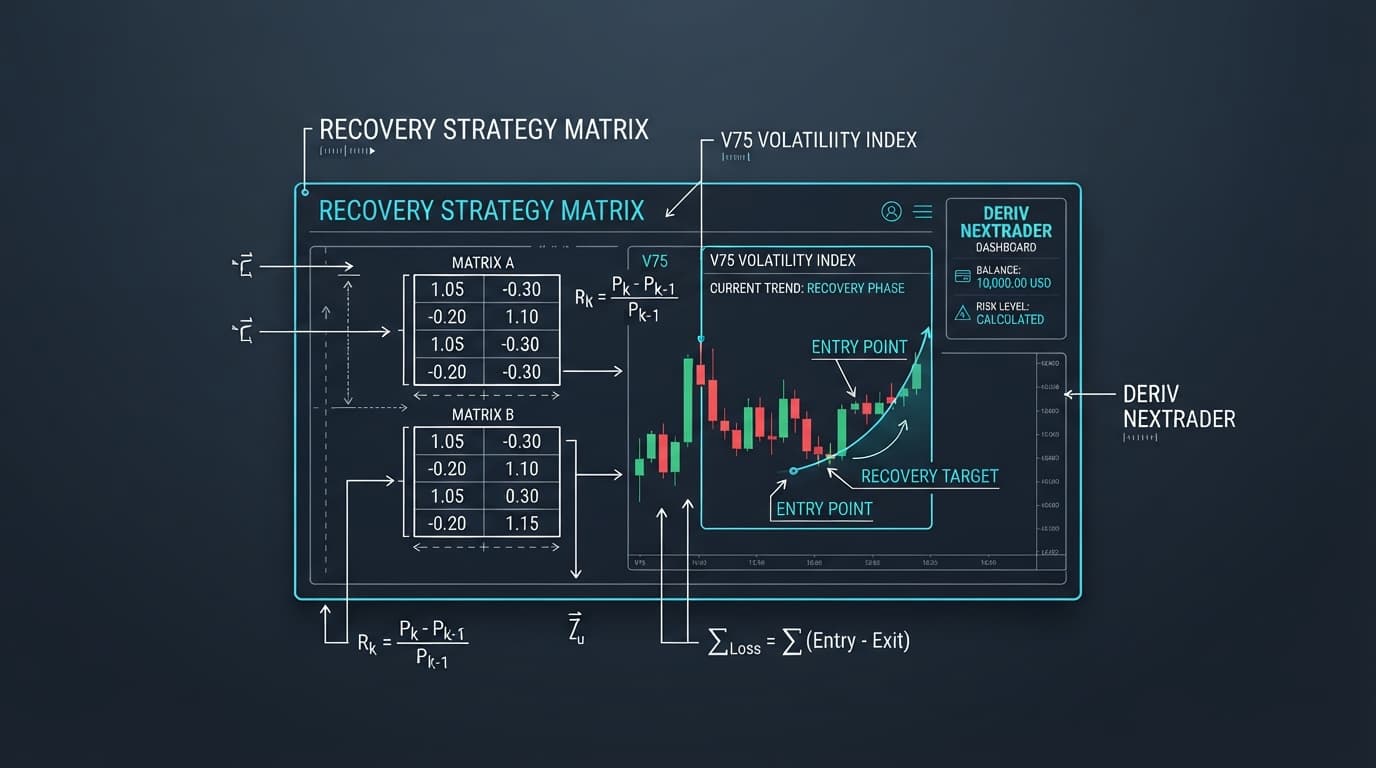
Money management is the cornerstone of sustainable trading, and Nextrader's Mesa Milano strategy offers a sophisticated approach to loss recovery. Unlike aggressive Martingale, Mesa Milano is a "smart loss recovery" system designed to recoup losses more intelligently without exponentially increasing your stake after every loss.
- Select Mesa Milano:
* In the "Money Management" section of the Auto Trader Bot, select "Mesa Milano" from the dropdown options. You'll also see "Fixed Stake" and "Martingale" available, but for this tutorial, we're focusing on Mesa Milano.
- Configure Mesa Milano Parameters:
* Initial Stake: This is the amount of your first trade. Start with a conservative amount, especially when testing.
* Target Profit: Define the profit amount you aim to achieve before the bot resets its cycle. This is crucial for Mesa Milano's logic.
* Loss Factor: This setting determines how much your stake will increase after a loss. Mesa Milano uses a dynamic factor, aiming to recover previous losses with a controlled increase, rather than a fixed multiplier.
* Max Number of Losses: Set a realistic maximum number of consecutive losses the bot should attempt to recover from within a cycle. This acts as a safety net, preventing the bot from chasing losses indefinitely.
* Max Stake: Crucially, set a "Max Stake" limit. This is the absolute maximum amount the bot will ever trade on a single contract, regardless of losses. This protects your capital from excessive risk during prolonged losing streaks.
* Stop Loss: Beyond the Mesa Milano settings, you can also set a global "Stop Loss" for the entire bot session (e.g., -$100). If your total session loss reaches this amount, the bot will automatically stop trading.
* Take Profit 1 & 2: You can also define global "Take Profit" targets for the session (e.g., +$50). The bot will stop once this cumulative profit is reached. These P/L targets provide essential risk management alongside Mesa Milano.
- Understand Mesa Milano's Logic:
* Mesa Milano continuously tracks your profit and loss within its current cycle. After a losing trade, it calculates the necessary stake for the next trade to recover previous losses and achieve the "Target Profit". It does this with a more controlled increase than Martingale, making it a safer option for loss recovery. It will reset the cycle once the target profit is hit or a new session begins. This intelligent approach to money management is one of the key strengths of Nextrader's deriv trading tools.
Step 5: Reviewing Settings and Starting the Bot
You're almost there! Before you hit the "Start" button, it's critical to perform a thorough review of all your configured settings to ensure everything is exactly as you intend. This minimizes potential errors and ensures your bot operates according to your strategy.
- Conduct a Final Review of All Parameters:
* Market: Confirm "Volatility 75 Index (V75)".
* Contract Type: Verify "Higher/Lower".
* Trade Duration: Check your selected duration (e.g., "5 Ticks", "1 Minute").
* AI Strategy: Ensure your chosen strategy (e.g., "Smart Signals", "Trend Hunter") is selected.
* Signal Timeframe: Double-check the timeframe (e.g., "5min", "10min").
* Higher/Lower Specifics: Confirm your "Barrier Offset" and "Payout" settings.
* Money Management: Verify "Mesa Milano" is selected.
* Mesa Milano Parameters: Crucially, re-check your "Initial Stake", "Target Profit", "Loss Factor", "Max Number of Losses", and especially your "Max Stake". These settings are vital for protecting your capital.
* Overall Session Limits: Confirm your global "Stop Loss" and "Take Profit" levels for the entire trading session.
- Select Your Deriv Account:
* Ensure that the correct Deriv account (demo or real) is selected for trading. You can switch between connected accounts if you have multi-account support enabled. Always start with a demo account to test your setup thoroughly before moving to a real account.
- Start the Auto Trader Bot:
* Once you are absolutely confident in all your settings, locate the "Start" button (usually prominent and color-coded) and click it.
* The bot will immediately begin monitoring the V75 market according to your chosen AI strategy and timeframe. When a valid signal is generated (only on closed candles, ensuring non-repaint accuracy), the bot will execute a Higher/Lower trade on your Deriv account, applying the Mesa Milano money management strategy.
- Monitor Live Performance:
* As the bot trades, Nextrader's real-time color-coded trading console will display live updates, including executed trades, entry prices, stop losses, take profits, and your live P&L tracking. This allows you to observe the bot's performance and make adjustments if necessary. Remember, Nextrader provides all the essential deriv trading tools for transparent automation.
Pro Tips
- Start with Demo: Always begin by testing your bot on a Deriv demo account. This allows you to fine-tune your Mesa Milano settings, observe the chosen AI strategy's performance on V75, and gain confidence without risking real capital.
- Combine Strategies: While this tutorial focuses on one AI strategy, Nextrader allows you to explore others like "Reversal Radar" (RSI-based), "Volatility Pulse" (Bollinger Bands), or "Swift Scalper" (Stochastic RSI) for different market conditions. You can even run multiple bots on different markets or strategies simultaneously using Nextrader's multi-account support.
- Monitor Signal Confidence & Timeframes: Pay attention to the confidence levels of signals generated by your chosen AI strategy. While the bot acts automatically, understanding these levels can inform your strategy adjustments. Experiment with different timeframes (5min, 10min, 30min, 1 hour) for signal generation to see which performs best for V75 Higher/Lower with your chosen strategy and duration.
- Leverage Telegram Signals: Even while your bot is running, you can cross-reference its actions or explore other markets by checking the Nextrader Telegram channel (Telegram). This provides real-time signals for 30 markets, up to 30 signals per day, offering additional insights and manual trading opportunities.
Start Trading Now
Ready to automate your Deriv V75 Higher/Lower contracts with intelligent money management? Head over to Nextrader App to log in, or sign up for your 100% free account at Sign Up Free — Nextrader. For real-time updates and signals, join our community on Telegram at Telegram.
Trading involves risk. Past performance does not guarantee future results.