Introduction
Welcome to this in-depth Nextrader tutorial, designed to empower you with one of the most sophisticated deriv trading tools available. This guide will walk you through the precise steps to automate your Deriv Volatility 100 1Hz Rise/Fall trades using Nextrader's cutting-edge Smart Signals and the robust Auto Trader Bot, all while employing the intelligent Mesa Milano money management strategy.
This tutorial is crafted for traders who are looking to move beyond manual trading, seeking to leverage advanced automation for consistent execution and disciplined risk management on the fast-paced V100 1Hz market. By the end of this guide, you will be able to configure a powerful, self-executing trading system that responds to high-confidence signals and intelligently manages your stake size, aiming for sustainable growth.
Nextrader offers 100% free access to all its features, enabling you to explore sophisticated deriv bots and binary bots without any subscription fees or paywalls. We provide real-time, non-repaint trading signals across multiple timeframes and markets, ensuring you always have reliable data at your fingertips.
What You Need Before Starting
- Deriv Account: A live or demo account with Deriv.com. We highly recommend starting with a demo account for testing.
- Nextrader Account: A free account on Nextrader (sign up at Sign Up Free — Nextrader).
- Basic Understanding: Familiarity with Deriv's Rise/Fall contract types and the concept of Volatility Indices, particularly V100 1Hz.
- Stable Internet Connection: Essential for uninterrupted signal reception and bot operation.
Step 1: Connecting Your Deriv Account to Nextrader
Before you can unleash the power of Nextrader's automation, you need to securely link your Deriv account. This crucial first step ensures that Nextrader's Auto Trader Bot can execute trades on your behalf.
Get Live AI Trading Signals
Real-time non-repaint signals from 11 AI strategies — Volatility Indices, Forex, Gold & Crypto. No subscription, no paywall.
- Auto Trader Bot
- Digit Trader Bot
- 11 AI Strategies
- Live Telegram Signals
- Log in to Nextrader: Navigate to Nextrader App and log in to your Nextrader account. If you don't have one, sign up for free.
- Access Account Settings: Once logged in, locate the "Settings" or "Account" section, usually found in the top right corner or a sidebar menu. Click on it to expand your account options.
- Navigate to API Token Integration: Within the settings, you'll find an option related to "Deriv API Token" or "Connect Deriv Account." Click on this.
- Generate Deriv API Token:
* Open a new tab and log in to your Deriv.com account.
* On Deriv, go to "Settings" > "API Tokens."
* Click "Create a new token."
* Give your token a name (e.g., "Nextrader Bot").
* Crucially, grant the necessary permissions: "Read," "Trade," and "Cashier." These permissions allow Nextrader to retrieve account information, place trades, and manage your balance for trading purposes. Do not grant "Admin" permission.
* Click "Create." Deriv will generate a unique API token (a long string of characters). Copy this token immediately.
- Paste Token into Nextrader: Return to your Nextrader platform and paste the copied Deriv API token into the designated field.
- Select Account Type: Choose whether you are connecting a "Real" or "Demo" Deriv account. For initial testing, always select "Demo."
- Connect and Verify: Click the "Connect" or "Save" button. Nextrader will attempt to establish a connection. Upon successful connection, your Deriv account balance (demo or real) should be displayed, and your account status will show as "Connected." This confirms Nextrader has the necessary access to act as your personal deriv bot.
Step 2: Selecting Your Market and Strategy: V100 1Hz with Smart Signals
With your Deriv account connected, it's time to pinpoint your trading target and choose the intelligent signal source. V100 1Hz is renowned for its rapid price movements, making precise signal generation critical.
- Access the Trading Console/Signals: From the Nextrader dashboard, navigate to the "Trading Console" or "Signals" section. This is where you'll monitor real-time market data and signal generation.
- Select Volatility 100 1Hz: In the market dropdown menu, scroll through the extensive list of available markets (Forex, Gold, Crypto, Volatility Indices) and select "Volatility 100 1Hz." This market is specifically designed for high-frequency trading, and Nextrader's signals are optimized for it.
- Choose a Timeframe: Nextrader offers signals for 5min, 10min, 30min, and 1-hour timeframes. While V100 1Hz is fast, choosing a slightly higher timeframe like 30min or 1-hour can often yield more robust and less noisy signals for automated Rise/Fall trading, especially when using Smart Signals. For scalping, 5min or 10min might be considered, but for automation with Mesa Milano, consistency is key.
- Select "Smart Signals" Strategy: From the "Strategy" dropdown, choose "Smart Signals." This is Nextrader's flagship multi-indicator strategy, meaning it requires a minimum of 4 indicators to agree before firing a signal. This multi-factor agreement significantly increases the confidence level of each signal, making it ideal for automated trading where false positives can be costly. You'll observe signals appearing with a "Confidence" level (e.g., 30-85%), along with Entry Price, Stop Loss, and Take Profit 1 & 2 targets. Pay attention to these details as they offer valuable context for each signal.
Step 3: Configuring the Auto Trader Bot for Rise/Fall Contracts
Now, let's move to the heart of the automation: setting up the Auto Trader Bot to act on the Smart Signals for V100 1Hz Rise/Fall contracts. This is where you translate the signals into actionable trades.
- Navigate to Auto Trader Bot: On the Nextrader platform, find and click on the "Auto Trader Bot" section. This dedicated module is your control center for automated deriv bots.
- Select Market and Contract Type:
* Under "Market," ensure "Volatility 100 1Hz" is selected.
* Under "Contract Type," choose "Rise/Fall." This tells the bot to exclusively execute Rise/Fall predictions based on the signals.
- Set Duration: For V100 1Hz, duration is critical. Since it's a 1Hz (one tick per second) market, short durations are common. You can set this in "Ticks" or "Minutes." For automated Rise/Fall, starting with 5-10 Ticks or 1 Minute is a common approach. Experimentation on a demo account is vital here to find what works best with your chosen timeframe for Smart Signals.
- Specify Signal Source:
* Under "Trade Type," select "Signals."
* Crucially, ensure "Smart Signals" is chosen from the "Signal Strategy" dropdown. This links your bot directly to the high-confidence signals we configured in Step 2.
- Set Signal Confidence Threshold: This is a powerful filtering tool. You can set a minimum "Signal Confidence" (e.g., 70%, 75%, or even 80%). The bot will only execute trades when a Smart Signal for V100 1Hz Rise/Fall is generated with a confidence level equal to or higher than your specified threshold. This helps filter out lower-probability signals and focuses on the strongest opportunities.
- Define Target Profit and Stop Loss: These are your overall bot-level profit and loss limits.
* Target Profit: The total profit the bot should aim to achieve before automatically stopping for the day/session.
* Stop Loss: The maximum total loss the bot should incur before automatically stopping. These are crucial risk management parameters for any automated binary bots setup.
Step 4: Implementing Mesa Milano Money Management
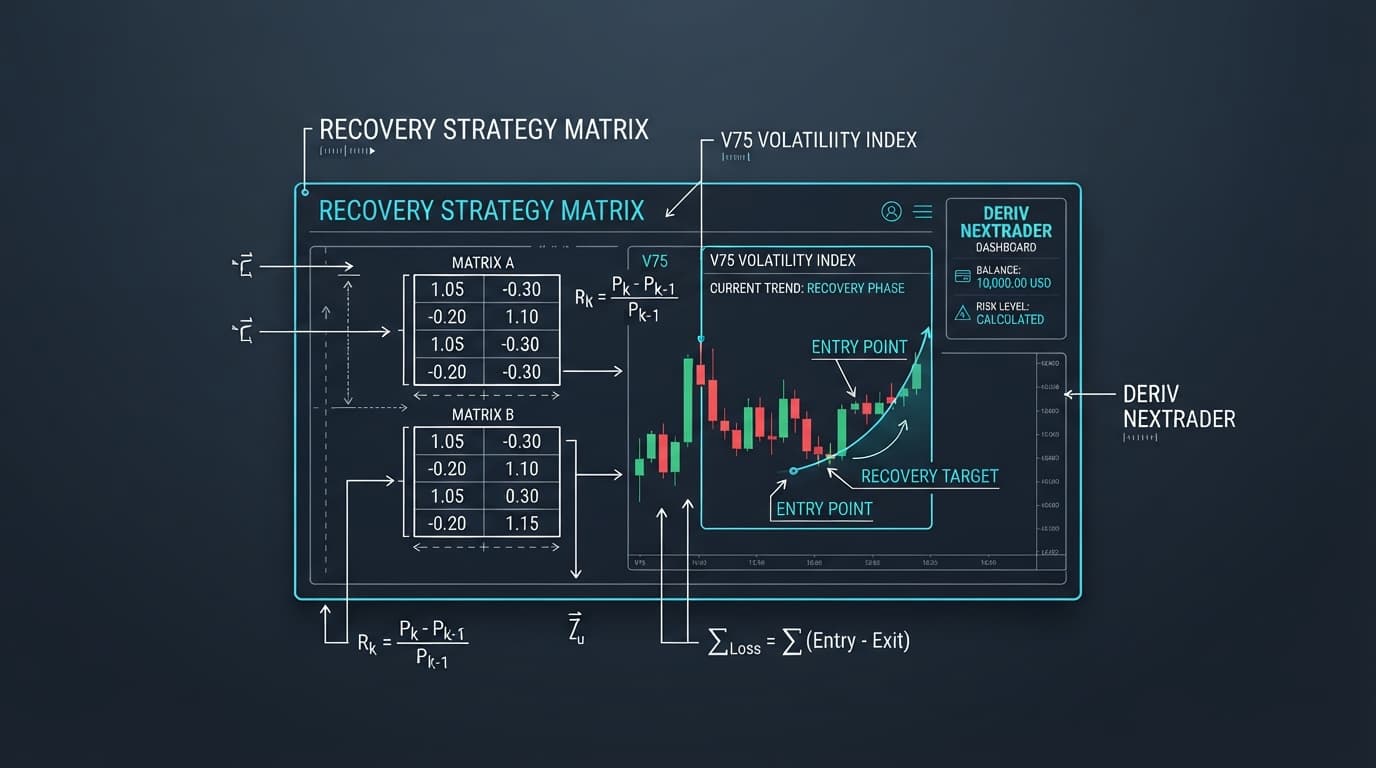
Nextrader's Auto Trader Bot offers advanced money management options. For this tutorial, we'll focus on Mesa Milano, a sophisticated strategy designed for smart loss recovery, distinguishing it from simpler approaches like Martingale.
- Access Money Management Settings: Within the "Auto Trader Bot" configuration, locate the "Money Management" section.
- Select "Mesa Milano": From the dropdown menu, choose "Mesa Milano." Unlike Martingale, which simply doubles the stake after a loss, Mesa Milano applies a more intelligent, calculated approach to recover previous losses without excessive risk escalation. It's a key feature among advanced deriv trading tools.
- Set Initial Stake Size: Define your starting "Stake Size" for the first trade. This should be a small, manageable percentage of your total capital, especially for V100 1Hz.
- Configure Mesa Milano Parameters:
* Recovery Factor: This is the core of Mesa Milano. It's a multiplier that determines how much the stake increases after a loss to recover previous losses. A common starting point might be 1.1x to 1.5x. A higher factor recovers faster but increases risk; a lower factor is safer but slower.
* Max Stake: Set a strict "Max Stake" limit. This prevents the bot from escalating the stake indefinitely, which is a critical safeguard against substantial losses, especially in volatile markets like V100 1Hz.
* Max Loss Streak: Define the maximum number of consecutive losses the bot should tolerate before resetting the stake or stopping. This acts as another important safety net.
* Target Recovery Profit: Some implementations allow you to set a specific profit target for the recovery phase, after which the stake resets to the initial stake.
- Understand Mesa Milano's Logic: Mesa Milano aims to recover previous losses plus a small profit by strategically increasing the stake. It calculates the necessary stake based on past losses and the recovery factor. It's designed to be more conservative than Martingale, providing a more sustainable path to recovery. However, no money management strategy guarantees profits, and careful parameter tuning is essential.
Step 5: Activating and Monitoring Your Automated System
With all settings meticulously configured, it's time to unleash your Nextrader deriv bot and observe its performance. Remember, vigilance and starting on a demo account are paramount.
- Review All Settings: Before starting, take a moment to double-check every parameter you've set: market (V100 1Hz), contract (Rise/Fall), duration, Smart Signals, confidence threshold, initial stake, and all Mesa Milano settings. Ensure everything aligns with your trading plan and risk tolerance.
- Start on Deriv Demo Account (Crucial!): Seriously, do not start with real money. Switch your Deriv account to "Demo" if you haven't already. This allows you to test the bot's behavior, validate your settings, and understand how it interacts with the V100 1Hz market without risking capital.
- Activate the Bot: Once confident in your settings and on a demo account, click the "Start Bot" button within the Auto Trader Bot section. The bot will now begin listening for Smart Signals for V100 1Hz Rise/Fall that meet your confidence threshold and execute trades according to your Mesa Milano money management rules.
- Monitor the Trading Console: Keep a close eye on Nextrader's real-time "Trading Console."
* Live P&L Tracking: You'll see your profit and loss updated in real-time.
* Executed Trades: Each trade executed by the bot will be listed, often color-coded (green for win, red for loss).
* Signal Status: You'll see when signals are received, their confidence levels, and whether a trade was placed or skipped (e.g., due to low confidence).
* Bot Status: The bot's current status (running, paused, stopped, reason for stopping) will be clearly indicated.
- Adjust and Optimize: Over time, analyze the bot's performance on your demo account.
* Are the Smart Signals performing as expected?
* Is the Mesa Milano strategy effectively recovering losses?
* Is your duration appropriate for V100 1Hz?
* Adjust your confidence threshold, duration, or Mesa Milano parameters as needed to optimize performance.
- Stopping the Bot: To stop the automated trading at any time, simply click the "Stop Bot" button. The bot will complete any pending trades and cease operation.
Pro Tips
- Start with Demo, Always: This cannot be stressed enough. The V100 1Hz market is extremely fast. Thoroughly test your Auto Trader Bot and Mesa Milano settings on a Deriv demo account for several hours or days before considering real funds.
- Fine-tune Signal Confidence: Experiment with the "Signal Confidence" threshold for Smart Signals. A higher threshold (e.g., 80%+) will result in fewer but potentially higher-quality trades, while a lower threshold might increase trade frequency but also risk. Find the sweet spot that aligns with your risk appetite.
- V100 1Hz Volatility Management: V100 1Hz is inherently volatile. While Nextrader's Smart Signals are robust, always be mindful of broader market conditions. Consider adjusting your duration or even pausing the bot during extreme volatility if you observe inconsistent performance.
- Leverage Telegram Signals: Supplement your bot's operation by monitoring the official Nextrader Telegram channel (Telegram). This channel provides real-time signals across 30 markets, offering additional insights and confirming market sentiment that can inform your bot's settings or when to enable/disable it.
Start Trading Now
Ready to revolutionize your Deriv trading experience? Head over to Nextrader App to access your free Nextrader account, or sign up directly at Sign Up Free — Nextrader. For real-time signal updates and community interaction, join our Telegram channel at Telegram. Harness the power of Nextrader's deriv bots and advanced trading tools today!
Trading involves risk. Past performance does not guarantee future results.