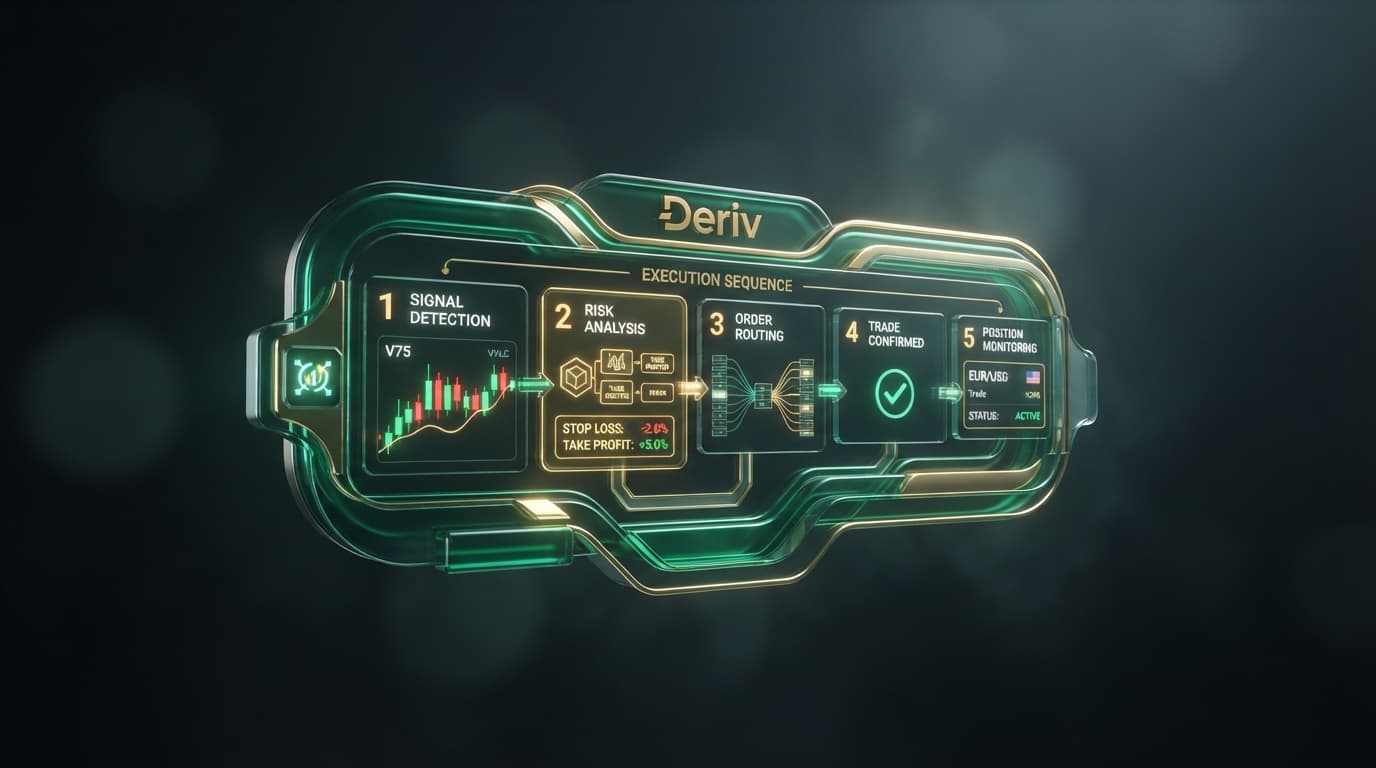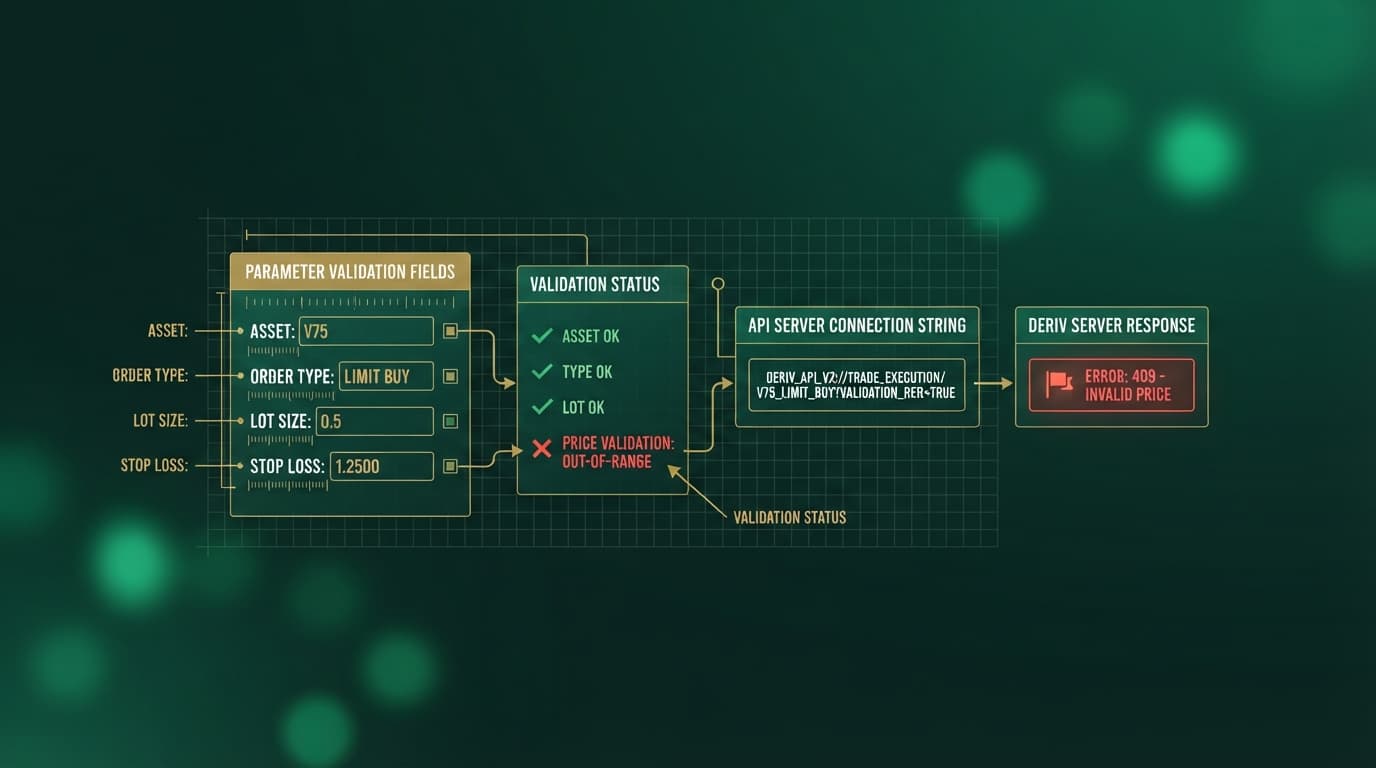

Your Deriv bot was 3 steps deep into a Martingale recovery on Volatility 75 Index when a momentary WebSocket timeout hit. Instead of retrying smoothly, Block 4 crashed or reset your stake back to $0.35—locking in a net loss. Here is how to fix your Block 4 error handling loop so API blips never wipe your strategy variables again.
When you configure an automated strategy for high-volatility synthetic indices, network packet loss or API rate limits will inevitably occur. Traditional Deriv Bot (DBot) and BinaryBot XML scripts rely on client-side block execution trees that treat a network disconnect as a fresh session start or a hard script crash. While you can edit individual blocks inside legacy XML files, switching to pre-built bots on NexTrader Bot eliminates manual block editing by executing trade logic through server-grade, fault-tolerant socket connections.
Most traders using native DBot XML setups dump their stake calculations into the generic trade loop without isolating the WebSocket response code. When the socket drops and reconnects, the script re-reads initial parameters, dumping your accumulated loss count and resetting your stake mid-sequence.
Quick Checks
- Verify your Deriv API token on NexTrader Bot has active Read and Trade scopes enabled before starting a session.
- Confirm your global
Initial_Stakevariable is declared exclusively in Block 1 ("Before Purchase") and never re-assigned inside Block 4 during an exception event. - Check if your bot is running on a high-frequency tick index, such as Volatility 100 (1s) Index (V100 1Hz), where rapid request rates trigger WebSocket rate limits (E.g.,
RateLimitorInvalidTokentemporary errors). - Test your modified XML logic on a live demo balance inside NexTrader Bot before deploying real capital.
- 1 Receive Trade Result in Block 4
- 2 Check if Contract Detail Object Exists
- 3 If Valid Result: Update Stake based on Win or Loss
- 4 If Network Error: Wait 3 Seconds and Trigger Retry Loop
Fix 1: Prevent Stake Variable Reset on Re-entry
- Symptom: The bot reconnects after a brief API disconnect on Volatility 75 (V75), but immediately opens the next contract at the base stake ($0.35) instead of the calculated Martingale recovery stake ($2.80).
- Cause: Placing variable initialization (
Set Current_Stake to Initial_Stake) inside the top-level execution scope of Block 4, or re-running Block 1 initialization code upon an unhandled API reconnect in DBot. - Exact change: You must separate your initial variable declarations from your post-trade evaluation. Open your script logic and ensure
Set Current_Stake to Initial_Stakeis strictly locked inside Block 1 ("Before Purchase / Run Once").
Inside Block 4 ("On Result / Trade Again"), create a three-way conditional structure:
Load a Free Deriv Bot in One Click
Browse 747+ ready-to-run Deriv bots — Rise/Fall, Over/Under, Even/Odd, Match/Differ. No coding, free forever.
- 747+ Free Bots
- One-Click Load
- Rise/Fall & Digits
- Demo or Real
- If
Contract Result is Win: ResetCurrent_StaketoInitial_Stakeand setLoss_Countto 0. - Else If
Contract Result is Loss: SetCurrent_StaketoCurrent_Stake * Multiplier(e.g., 2.1) and incrementLoss_Countby 1. - Else (Socket Error / Timeout / Undefined Result): Leave
Current_StakeandLoss_Countcompletely untouched. Call the retry sub-routine directly without modifying any trading metrics.
By structuring Block 4 this way, any socket disruption that forces a trade retry preserves your exact location in the recovery progression.
Fix 2: Implement a Retry Pause Loop for WebSocket Rate-Limits
- Symptom: The execution log spams API rate-limit errors (such as
Request rate limit exceeded) before the entire bot halts execution completely. - Cause: When network latency spikes, Block 4 instantly attempts to invoke the purchase block again without giving the WebSocket buffer time to process pending frames. This triggers protective rate-limiting from the Deriv API infrastructure.
- Exact change: Add an explicit delay mechanism inside the error-handling branch of Block 4 before invoking the
Trade Againblock.
Do not re-purchase immediately upon detecting a network exception. Instead, insert a 2-second to 5-second Sleep / Wait block directly into the error branch. This brief pause flushes the socket buffer, clears stale request IDs, and re-establishes a clean connection state with the Deriv servers.
For high-frequency contracts like 1-Tick Rise/Fall or Over/Under, this small pause prevents your account from being temporarily throttled due to rapid-fire re-submission attempts.
Fix 3: Isolate Contract Result Verification from Network Status
- Symptom: The bot hangs indefinitely showing a status of
Contract details unavailablein the execution log and refuses to fire the next trade. - Cause: Block 4 attempts to evaluate
Is Result Win?on a null or undefined payload object because the server failed to deliver the closing contract event over the socket before the connection dropped. - Exact change: Wrap your entire win/loss evaluation tree inside a structural check for
Contract Detail Exists.
Before evaluating the win or loss condition, verify that the return object contains valid contract data. If the script finds that Contract Detail is null, direct the execution path to a dedicated reconnect routine rather than letting the script hit an unhandled JavaScript exception.
The reconnect routine should verify connection status, pause for 3 seconds, and re-query contract status or safely invoke Trade Again with your stored Current_Stake intact.
Fix 4: Eliminate DBot XML Resets with Native Engine-Level Handshakes on NexTrader
- Symptom: Custom ~48-block XML scripts imported into legacy DBot or BinaryBot environments continue to freeze, crash, or experience micro-lags on fast 1-Tick synthetic markets despite manual block edits.
- Cause: Legacy DBot XML block structures process high-frequency tick data through unoptimized client-side browser event loops. When network jitter occurs, browser tab throttling drops WebSocket heartbeat packets, breaking Block 4 execution logic and forcing a full script restart.
- Exact change: Reframe how your bots execute by moving from manual XML block maintenance in DBot to native server-side error handling on NexTrader Bot.
Rather than constructing fragile ~48-block XML scripts from scratch in DBot, you can connect your Deriv API token to NexTrader Bot and run speed-optimized free Deriv bots in one click. The platform features an architectural engine that isolates state memory from network drops, retaining variable values like accumulated loss counts even when WebSocket frames drop.
The NexTrader Bot Hub provides over 747+ ready-to-run bots across Free Bots and Premium Bots tiers, covering Rise/Fall, Over/Under, Even/Odd, Match/Differ, as well as Tick, Indicator, and Candle strategies:
- Rise Rocket & Fall Falcon: 1-Tick and 1-Tick Turbo Rise/Fall bots engineered with persistent variable retention during socket re-handshakes.
- Under 8 Flash & Over 2 Blaze: 1-Tick Turbo Over/Under bots optimized for rapid tick processing without hitting API rate limits.
- Even Comet & Odd Bolt: Digit bots featuring built-in micro-pause loops to absorb network jitter seamlessly.
Every free Deriv bot on NexTrader Bot loads instantly on your Deriv demo or real account, featuring live balance tracking, Run/Stop controls, and real-time dashboard execution logs.
If your Deriv account was created through NexTrader, claim the NexTrader Welcome Pack at gifts.nextrader.live. This free claim unlocks 100+ premium XML binary bots, 3 months of Bot Hub Premium ($14.99/mo value), and 3 months of access to our VIP signal channel (t.me/nextrader_signals). Account eligibility is verified automatically by Deriv when you log in.
Keep It From Happening Again
To ensure your Deriv trading bot runs without manual intervention during extended sessions, implement these operational rules:
- Strictly isolate calculation logic from transport logic: Keep stake multipliers, loss counters, and profit targets isolated from API call status checks in Block 4.
- Always test reconnect routines on a demo account: Before trading real capital on Volatility 100 (1s) Index or Gold synthetics, simulate disconnects on a demo balance at NexTrader Bot to confirm that
Current_Stakeremains unchanged after network interruptions. - Avoid hardcoding recovery values inside purchase blocks: Store all risk parameters in global variables declared at initialization to prevent scope-shadowing errors during execution loops.
- Configure explicit API heartbeat timeout parameters: Set a 10-second socket timeout threshold inside your execution settings to force an immediate token re-handshake before Deriv drops the active channel.
Ready to eliminate bot crashes and state resets for good? Launch pre-optimized, connection-resilient strategies instantly on the NexTrader Bot Hub.
If you need a new trading account or want to link your existing setup, visit NexTrader Signup to get started, and join thousands of active traders in our official Telegram for daily technical updates and automated strategy insights.
Trading involves risk. Past performance does not guarantee future results.